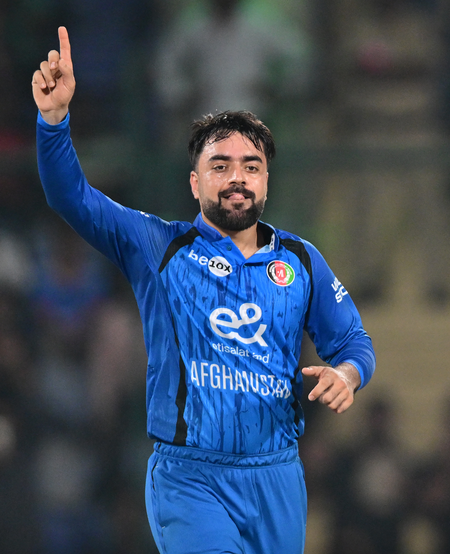
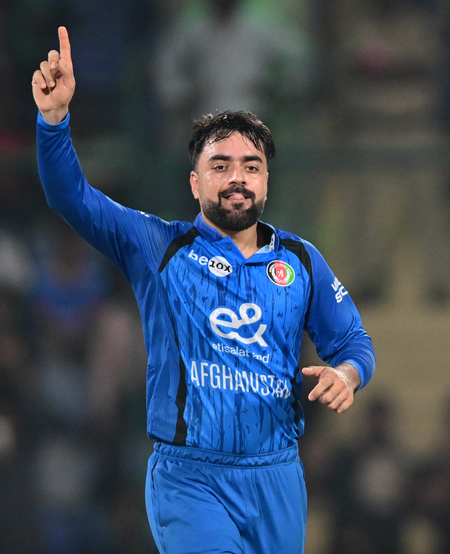
New Delhi, Sep 16 (IANS) There is a particular kind of calm about Rashid Khan these days. The leg-spinner who once seemed to exist purely as a wicket-taking force of nature is now at his warm and affable self on the eve of the third T20I against India, a game which Afghanistan have to win to avoid a 3-0 series defeat.
On Tuesday night at the Arun Jaitley Stadium, where Afghanistan faltered yet again, Rashid was the exception for the designated hosts: 28 with the bat, and 3-36 with the ball. The runs, in particular, were not an accident, so as were the three boundaries he hit off Arshdeep Singh in the 18th over (with the inside-out loft over cover for six being the standout).
“They were the product of a shift that began the day he walked into the Gujarat Titans dressing room in the IPL and was told he was no longer merely a bowler who could swing a bat. “I have always wanted to bat; I started playing cricket by batting. I always wanted to bat. For a team, 20-25 runs are very important, and I wanted to do that for my team, especially in T20s. So how can I do that? Earlier, I didn’t get that much batting.
“But since I came to Gujarat Titans, I have been getting more batting in the net sessions. Ashish (Nehra) bhai told me that I will play as a batter too and not just as a bowler. So, I focused more on batting. By working on and improving my batting, when I make runs in the match, I automatically get more confidence. It comes from confidence, and when that goes high, the practice and hard work pay off,” Rashid told IANS in an exclusive interaction facilitated by Red Bull on Wednesday.
The technical work and success in batting have been made possible by someone who is not someone who appears in the headlines. Naeem Amin, who Rashid met during his time at Gujarat Titans, is the man the premier leg-spinner calls first when something feels off. Amin, who also trained India stars Virat Kohli and Hardik Pandya before they were in England, was quick to message Rashid after Tuesday’s game was over.
“He has helped me a lot. To be honest, all my improved batting has been done by Naeem Amin. Not just in batting, but also in bowling. I always talk with him. Last night, when the match was over, he messaged me, saying that I had a lot of fun. But what I enjoyed the most was when you hit a six over mid-off against Arshdeep – that was the best effort for me.
“To be honest, before we came here, I had done 3-4 sessions with him. We were working on how to play straight, how to hit a straight six, and not hit cross-bat. He was very happy that I hit a straight six. He helped me a lot. My go-to person is Naeem Amin. I go to him and ask him what I did wrong and what I can do better.”
If Afghanistan’s arrival as a side capable of beating anyone has a starting point, Rashid places it squarely at the 2023 ODI World Cup in India – the tournament where the underdog tag stopped being an excuse and started being a weapon. It also has a New Delhi connection – they beat the then-reigning champions England and sent their loyal supporters back home in euphoria.
“Exactly, everything started from here. In the 2023 World Cup, we defeated England, then we defeated Sri Lanka and Pakistan — we defeated big teams. Australia was also close, but it was an innings Maxwell played and changed the game. In the 2024 World Cup, we defeated New Zealand, then we defeated Australia and reached the semifinal,” recalls Rashid.
The list has only grown since. But Rashid is wary of a team that celebrates upsets rather than expects results, and he keeps returning to the same word. “In the Champions Trophy, we defeated England in Pakistan. It was a great achievement for us in the last 3-4 years. That’s when our cricket reached another level. Now, it’s a tough challenge for us to maintain consistency.
“We want to do it again and again — we don’t just do it once, and that’s it. That is because when you do it again and again, that’s when you show consistency. It’s a big challenge for us. It was a tough match for us against South Africa in the T20 World Cup; we played in a double super-over, and we didn’t win the match.
“I think it’s a positive thing that we played well and performed well. We will try to do better. We will try to find a way to defeat big teams again and again. When there is pressure, we will control ourselves and focus on our skills.”
The one subject on which Rashid’s fluency briefly deserts him is the T20I captaincy role, which he held till Afghanistan exited this year’s T20 World Cup at the group stage. When that captaincy was taken from him and given to Ibrahim Zadran, Rashid let out a laugh.
“Le li (it was taken). I mean, I don’t understand. Whatever happens, it will be for the good. We don’t know what the future holds for us. For me, it was my destiny to lead Afghanistan to this much. It was the same for Jonathan Trott. It was his destiny. I always wanted to lead the team and do well.
“But there are some things that you can’t control. You have to accept, as a player, that you have to move on and play for the country. I know it’s not there, but hopefully, Ibrahim is a good young guy. We all know how skilful he is. Hopefully, he can lead the team and win more matches in Afghanistan.”
For a cricketer whose career was briefly affected by back surgery after the 2023 ODI World Cup and extensive pain management after that, the most significant scoreline of 2026 is no complaints, no pain, no management plans. To achieve that, red-ball cricket, Rashid’s favourite format, has been put on the back burner.
“It’s been sabse zabardast (very fantastic). I want every year to be like this one only – 2026. I want to perform well and try to do well. So far, it’s great in both formats, T20 and ODIs. The biggest thing is that my back supports me a lot. It helps me a lot, and I don’t get any complaints from my back. So, I’m so happy about that.”
That turnaround, he says, owes a great deal to a few days in Austria at Red Bull’s High Performance Centre in Salzburg, Australia, where the diagnosis was less about treatment for the back. “Yes, it was very important. I was struggling a lot with my back. Then, I went to Red Bull’s High Performance Centre in Austria. I wanted to do a full-body check-up to see where I could do better and the areas where my back was having problems.
“Even after the surgery, I was getting pain little by little. The 2-3 days that I spent there were very big days for me because I did a check-up of my whole body and found out my strengths and weaknesses. I was so impressed with it that I wanted to go again. Inshallah, I will go there for 2-3 weeks for training only.
“It was a good experience where I clearly got an idea of my body. We did a full-body check-up, and then for half a day, we sat with the physiotherapists and discussed the areas that needed to be improved by showing them on the screen. That really helped me and gave me a clear picture of where I do better. It’s simple for me.”
Apart from the recovery, the nutrition aspect has been super simple for Rashid, whose favourite food is Dal Makhani. “It’s simple for me. I don’t exercise too much, don’t do much extra dieting, or eat everything, and I try to keep it simple. I am not strict – like, I don’t have a weight machine with me, and I eat too much or too little, and I try to eat only what is good for myself and my health, as if you become rigid, then the guy becomes mentally affected.
“Sometimes, I feel like I want to eat biryani today and then have it once a week. I mean, too many restrictions are also not fine – like no biryani at all. But I try to eat as much healthy food as possible. We all know what is healthy and what is not. You don’t ask anyone about that.
“The more you eat healthy food, the less unhealthy stuff you eat, and your diet automatically goes as per that. I don’t focus much on high-protein things. Whatever the body wishes to eat, I do that to give it sukoon (peace). If the body is happy, then you are also happy.”
Ask him what has changed most in the last 12 months and the answer has nothing to do with cricket. Rashid’s son, Azlan, has rewired how quickly he can leave a bad day behind and, going by his own admission, that has had a startling effect on his wicket column.
“Before he was born, my mind wouldn’t get fresh quickly. But now when I see his face or video-call him, my whole body relaxes. He is also a lucky charm for me. Since he came to the ground for the first match in England, I took five wickets. Then, in 3 matches, he came to Ireland, and I took 12 scalps.
“He is a lucky charm. He woke up during last night’s match and watched it when I picked three wickets. He was sleeping in the previous match, and that’s why my performance was not good. He is my happiness. He is my lucky charm. It’s a different feeling.”
With a younger group now coming through, Rashid and his contemporaries find themselves in the role of custodians – telling the newcomers not just where Afghanistan cricket is, but what it cost to get here. “We do talk to them. But we have put in a lot of effort, practised a lot, and given a lot of qurbani (sacrifices). All of it was done by the senior players, and I think this stage is the result of that.
“It’s not like we got some things for free. We have put in a lot of effort. It’s a matter of where we started to where we are now – like from starting by playing against small teams to beating big sides. We do talk about it, but how to bring consistency in that and defeat them constantly and always bring in good performances.”
Home, for this team, is largely an idea sustained across hotel rooms in other countries, including playing away games. Rashid’s squad packs it the only way it can – in small, edible, and familiar things. “It’s difficult to take so many things from Afghanistan with us. We don’t spend much time in Afghanistan. But people’s love and prayers are always with us, wherever we go.
“We can’t take anything else with us, apart from their love and prayers. But we do carry the most famous dry fruits in Afghanistan to bring that home-like feeling. Like we eat dry fruits and have green tea in Afghanistan. We do the same around it so that we get back that feeling. Hopefully one day we can play an international match in Afghanistan – in Kabul and other cities. It’s going to be a dream.”
New Delhi, meanwhile, is a city he knows well enough to have a favourite haunt he can no longer visit in peace – Mazaar, a popular Afghan cuisine serving restaurant in Lajpat Nagar, a place where the diaspora is supremely active, apart from Bhogal in Jangpura.
“It’s very difficult to go to Lajpat Nagar now. Before, it was fun going there – no one would recognise us, and we would go to easily eat food and have fun. But it’s difficult now, though at the same time, it’s good – the food comes from there, and we eat in the hotel. But it’s still good.”
For all the records, franchise titles and wickets in every league on planet Earth, Rashid’s definition of a career well spent will come down to a single, unclaimed piece of silverware – an ICC title. Afghanistan came within touching distance of it in the 2024 Men’s T20 World Cup, when they entered the semi-finals.
“As far as what will be the legacy ten years down the line, I think it’s about providing good services for Afghanistan and how many matches I get to win for Afghanistan.
“But the most important thing is that I want Afghanistan to win one World Cup by the time I am there in the team. I think this will be a big achievement for me. I hope that before I retire, I have this in the book that yes, we won the championship or a World Cup, whether it is T20 or ODI,” he signed off.
–IANS
nr/bsk/