
‘BJP wants to own everything’: Akhilesh Yadav in LS during Vande Mataram debate


Mumbai, March 25 (IANS) The salaries of Central government employees may increase by Rs 14,000 to Rs 19,000 per month after the implementation of the 8th Pay Commission report, according to a report by Goldman Sachs on Tuesday.
The global financial services firm stated that around 50 lakh Central government employees and 65 lakh pensioners are expected to benefit from the pay revision.
The commission is likely to be formed in April, with its recommendations expected to be implemented in 2026 or 2027.
Goldman Sachs conducted an analysis to estimate the salary hike.
Currently, central government employees earn a median monthly salary of Rs 1 lakh before tax.
Based on different budget allocations, the firm projected possible salary increases.
If the government allocates Rs 1.75 lakh crore for the 8th Pay Commission, and half of this amount is used for salary revision while the rest is for pensions, the median salary could rise to Rs 1,14,600 per month.
If the allocation increases to Rs 2 lakh crore, salaries may go up to Rs 1,16,700 per month, and with an allocation of Rs 2.25 lakh crore, the median salary could reach Rs 1,18,800 per month.
For comparison, the implementation of the 7th Pay Commission in 2016 had cost the government Rs 1.02 lakh crore, according to the report.
Although the revised salaries and pensions were applied retrospectively from January 2016, they were actually rolled out from July 2016, impacting the financial year 2016-17, said Goldman Sachs.
Once formed, the 8th Pay Commission will consult with various stakeholders to determine the fitment factor and other details regarding salary and pension revisions.
Employee unions have hinted that they may demand a fitment factor of 2.57 or higher, similar to what was recommended under the 7th Pay Commission.
–IANS
pk/na/vd

Lucknow, April 14 (IANS) Bahujan Samaj Party (BSP) supremo Mayawati on Monday paid tributes to Dr Bhim Rao Ambedkar on his birth anniversary and called upon Dalits, backward classes, Adivasis, and other marginalised communities to unite in order to attain what she described as the “master key to power.”
Dr B.R. Ambedkar, born on April 14, 1891, in the military cantonment town of Mhow in Madhya Pradesh, was a jurist, economist, social reformer, and political thinker who left an indelible mark on Indian society.
As the principal architect of the Indian Constitution, he chaired the drafting committee and later became the first Law and Justice Minister in the cabinet of then-Prime Minister Jawaharlal Nehru.
Taking to social media platform X, Mayawati said, “Today, on Baba Saheb Dr Bhimrao Ambedkar’s birth anniversary, under the aegis of Ambedkarwadi Party BSP, salutations, garlands and immense tributes were offered to the maker of the Constitution, Bharat Ratna Bodhisatva, most revered Baba Saheb across the country, for which heartfelt gratitude and thanks are expressed to everyone.”
She urged marginalised communities to embrace Ambedkar’s vision not just ceremonially but with a committed missionary zeal.
“All the Dalits, Adivasis, backward classes and other marginalised communities of the country must truly become missionary Ambedkarites. Their liberation from injustice and exploitation lies in their unity and in attaining the master key to power, which alone can make them the ruling class,” she said.
April 14 is observed nationwide to celebrate the legacy of Dr Ambedkar, the architect of India’s Constitution and a towering figure in the struggle for social justice.
On this day, programs, cultural events, and rallies are organised to commemorate his lifelong commitment to the principles of equality, education, and the empowerment of the oppressed.
Taking a sharp dig at the current and previous governments, Mayawati alleged that the condition of the Bahujan communities remains grim.
“The social, economic and political conditions of the Bahujans in the country are as pathetic in the BJP rule as in the Congress rule. Due to a planned attack on their constitutional right to reservation, their situation is now turning into bad days instead of good days, which is very sad and worrying,” the BSP chief added.
–IANS
sd/

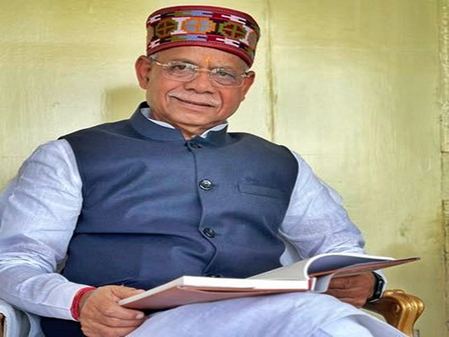
Shimla, Feb 16 (IANS) Himachal Pradesh Governor Shiv Pratap Shukla on Monday surprised legislators on the opening day of the Budget Session by finishing his 50-page customary address in just a couple of minutes here, skipping portions relating to the 16th Finance Commission.
Political observers said the Governor sidestepped a politically sensitive issue regarding the discontinuation of the Revenue Deficit Grant (RDG) by the 16th Finance Commission, a crucial issue impacting small and hill states.
However, they believe the Governor has set an “aggressive tone” for the main Opposition BJP, which has been blaming the Congress government for fiscal mismanagement and for allegedly halting Central-funded mega projects like a medical device park that would help improve the state’s economy, citing stubbornness, corruption and gross mismanagement.
In his address, the Governor read only the opening lines of his speech relating to the passage of supplementary demands for 2025–26, the Budget for 2026–27, and other legislative business.
The Budget Session begins with the address of the Governor, and his address usually exceeds well over an hour and lists out the achievements of the government.
In 2015, then Governor Kalyan Singh had finished his 39-page address in a couple of minutes.
At that time also, there was a Congress government in the state.
“Since paragraphs three to sixteen of my speech pertain to a constitutional body, I would not like to read them,” said Shukla.
He wrapped up his 50-page speech in under three minutes, reading only the first two paragraphs that outlined the session’s agenda — passing supplementary demands for 2025–26, the Budget for 2026–27, and other legislative business.
The speech had noted that Article 275(1) of the Constitution provides grants to states unable to bridge the gap between revenue and expenditure.
Historically, from the first Finance Commission in 1952 through the 15th Finance Commission (2020–25), Himachal Pradesh had consistently received RDG.
Paragraphs 15 and 16, which the Governor skipped, emphasised that the 16th Finance Commission’s decision to discontinue RDG would significantly affect small and hill states, particularly Special Category States like Himachal Pradesh.
The speech had stressed that for hilly and border states, where revenue generation is limited due to geography and natural resources, the RDG plays a critical role in funding development projects, social welfare schemes, and disaster management programmes.
Responding to the Governor’s decision to skip reading the entire customary address, Chief Minister Sukhvinder Singh Sukhu downplayed the Governor’s decision, saying it was “not an exception” as Governors have skipped addresses in the past.
On the state’s financial scenario, he said: “This is not about the government; RDG is our right. Do not harm the rights of the state.”
–IANS
vg/pgh