Mumbai, Jan 16 (IANS) Maharashtra’s “double engine” Centre-state leadership seems to have laid the track for the ruling Bharatiya Janata Party-led Mahayuti alliance’s urban sweep in civic body polls, consolidating the bloc’s post‑Assembly election momentum.
The civic elections indicate the state’s ruling alliance remains popular in most parts of the state despite “friendly contests”, challenge from the reunited Thackeray cousins, and Congress’s efforts at revival amidst Rahul Gandhi’s “vote theft” slogan.
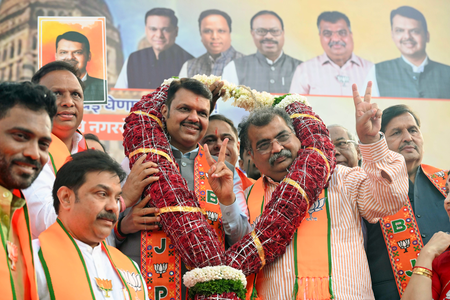
The Mahayuti has established itself across major municipal corporations, eroding space for the Thackeray camp and Congress in key cities. It is set to secure a majority in Brihanmumbai Municipal Corporation (BMC), ending the long-standing dominance of the then-undivided Shiv Sena, with the BJP emerging as the single largest party.
Similar scores marked in Pune, Thane, Nashik, among others.
Prime Minister Narendra Modi has thanked the people of Maharashtra in a social media message, posting on X in Marathi: “Thank you, Maharashtra! The enthusiastic people of the state have blessed the NDA’s agenda of public welfare and good governance!”
He added, “The results of various municipal corporation elections show that the bond between the NDA and the people of Maharashtra has become even stronger. The experience of our performance and the vision of development have touched the hearts of the people. I express heartfelt gratitude to all the people of Maharashtra. This mandate will give greater momentum to progress and is a celebration of the glorious culture connected with the state.”
By afternoon, tallies showed the BJP leading in hundreds of wards, while the Eknath Shinde‑led Shiv Sena was also posting strong numbers. In initial trends, the Shiv Sena started strong in Kalyan‑Dombivli, Navi Mumbai and Ulhasnagar, with the party leading on several dozen wards in those municipalities.
Meanwhile, in Pune and Pimpri‑Chinchwad, the BJP made notable inroads.
Elections were held for 2,869 seats across 893 wards in the state on Thursday, January 15, where over 1.03 crore voters participated in the civic polls this year, which last took place in 2017 – postponed due to COVID-19, legal hurdles, and delimitation of wards.
Counting took place at 23 designated centres spread across Mumbai amid tight security arrangements and high police deployment. The process was held in each centre under the supervision of an Election Returning Officer.
In the November 2024 Maharashtra Assembly elections, where the alliance consolidated power at the state level, crated a backdrop that framed the municipal contests as a continuity test for the ruling coalition. The civic sweep also builds from an urban tilt, effective local organisation, targeted campaigning on development and civic issues, and a fragmented opposition.
The coming together of Shiv Sena (Uddhav Balasaheb Thackeray) and Raj Thackeray’s Maharashtra Navnirman Sena (MNS), along with Congress’s efforts at reinventing itself since its Lok Sabha performance earlier failed to translate into comparable ground mobilisation in many wards.
The civic results follow the Mahayuti’s decisive performance in the November 2024 Assembly election, where the BJP won 132 – a gain of 27 seats from 2019 – of the state’s 288 constituencies. Among its allies, the Eknath Shinde-led Shiv Sena won 57 and Ajit Pawar’s Nationalist Congress Party (NCP), 41, where both parties had split ahead of the Vidhan Sabha poll.
This was in contrast to the April-May Lok Sabha polls, when the BJP suffered a 14-seat deficit from the previous election, winning only nine of the 48 Parliamentary constituencies in Maharashtra. The Congress managed to consolidate itself – winning 13 seats – against a single victory in the previous 2019 Lok Sabha poll.
Now the civic sweep strengthens the Mahayuti’s control over urban governance, giving it leverage over municipal budgets, appointments and local delivery. For the opposition, the results have again exposed organisational weaknesses and the need for clearer local narratives.
The outcome also signals that urban voters are rewarding perceived administrative performance and visible civic work, rather than purely identity or regional appeals.
–IANS
jb/uk