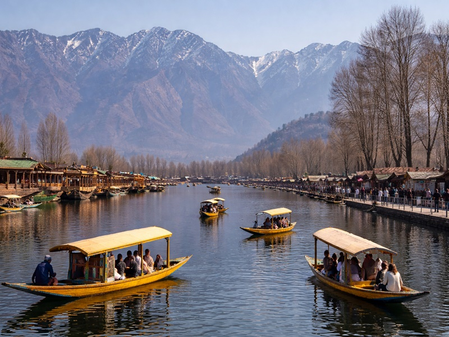
Srinagar, Feb 21 (IANS) Srinagar recorded its highest-ever maximum temperature for the month of February, with the mercury touching 21 degrees Celsius on Saturday, according to the Meteorological (MeT) Department.
In a statement, the MeT Department said that the maximum temperature recorded in Srinagar on Saturday was 21 degrees Celsius, marking the highest maximum temperature ever recorded in the city during the month of February.
The previous highest maximum temperature for February was recorded at 20.6 degrees Celsius on February 24, 2016.
Saturday’s temperature was around 10 degrees above the normal for Srinagar, indicating a significant departure from seasonal averages.
Other parts of the Kashmir Valley also recorded relatively high temperatures, with Gulmarg registering a maximum of 11.5 degrees Celsius and Pahalgam recording 17.2 degrees Celsius.
In the Jammu region, Jammu city recorded a maximum temperature of 25.2 degrees Celsius, which was 2.9 degrees above normal. Katra recorded 25 degrees Celsius, while Batote registered 19.9 degrees Celsius, Banihal 19.8 degrees Celsius, and Bhaderwah 21.3 degrees Celsius.
Jammu and Kashmir has witnessed below-average rainfall and snowfall during the current winter season, and the higher-than-normal temperatures in February have raised concerns among farmers, agriculturists, and orchardists.
Lower precipitation during winter can lead to shortages of drinking water and reduced availability of irrigation water during the summer months.
The situation has been further aggravated by significantly lower snowfall during the 40-day harsh winter period known as ‘Chillai Kalan’, which begins on December 21 and ends on January 30 each year.
This period is traditionally marked by heavy snowfall, which helps replenish glaciers and mountain water reservoirs that sustain water supply during the summer.
However, snowfall during the recent Chillai Kalan period was limited and occurred mainly towards its end, raising concerns about water availability.
With temperatures rising unexpectedly in February, the likelihood of significant snowfall in the coming days has diminished, increasing concerns over water resources.
As a result, March is now seen as a crucial period for snowfall that could help replenish mountain water reserves ahead of the summer season.
–IANS
sq/pgh