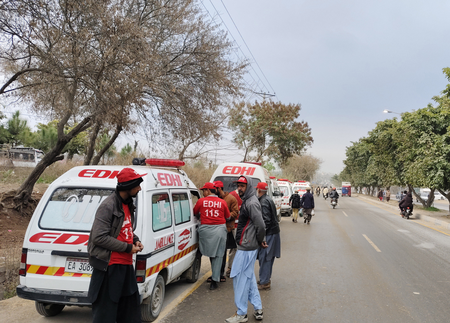
Islamabad, Feb 23 (IANS) The Islamic State Khorosan Province’s (ISKP) suicide bombing targetting a Shia mosque in Pakistan’s Islamabad, which claimed 36 lives and injured over 160 others during February 6 Friday prayers should raise concerns within the state on several levels as it indicates the possible emergence of another militant front in the country.
“The attack punctured what is routinely described as the country’s most fortified zone, signalling that the operational capacity of the terrorists cannot be dismissed as merely residual. It also risks reigniting sectarian fault lines in the country that had been subdued in recent years. Most critically, the attack points to the possible emergence of yet another militant front alongside the Pakistani Taliban and Baloch militants,” Islamabad-based journalist and analyst Ihsanullah Tipu Mehsud wrote in ‘The Express Tribune’ magazine.
The ISKP which has a presence across the region from Central Asia to Turkey has faced significant losses in recent years. Despite these significant losses, the group has managed to carry out sporadic but highly unpredictable attacks in Pakistan and other nations, which have left state authorities in a state of shock. Since its formation, the ISKP’s parent organisation, the Islamic State in Iraq and Levant (ISIL), has consistently adhered to an anti-Shia ideology. Over time, the ISKP expanded its targets to the US, China, Russia and other nations.
“A close examination of the ISKP’s propaganda content reveals that the spread of anti-Shia content is an enduring theme, ranging from the generation of extreme hatred to the incitement of extreme violence against Shias. The ISKP’s rivalry with the Taliban-led Afghan interim government, and even Hamas, is also closely tied to their ties with Iran, with the group viewing anyone who befriends Iran as a prime target,” wrote Mehsud.
The attack on mosque in Islamabad was followed by several statements on mainstream and social media, with many speculating that it was either an attempt to disrupt the Pakistan Tehreek-e-Insaf’s (PTI) announced protests against election rigging or the Basant festival in Lahore. The festival, which is centuries-old celebration of spring, was recently reinstated by Punjab Chief Minister Maryam Nawaz after a ban of nearly 20 years.
“However, it is crucial to acknowledge that the operations of non-state actors are multifaceted, aiming to not only inflict physical damage on their enemies but also to achieve political and propaganda objectives by creating mistrust, social and political polarisation, and moral decay. To understand militancy properly, it’s essential to recognise its patterns. Such attacks don’t occur overnight; rather, they involve weeks of meticulous preparation, including training in handling explosives, arranging transportation to the target location and securing accommodation in the vicinity while concealing identities,” Mehsud wrote in ‘The Express Tribune magazine.
Furthermore, extensive survey is conducted at the planned target site to gather intelligence on security protocols and find potential vulnerabilities. After all preparations are complete, militant organisations act swiftly to carry out the attack being detected and arrested by the authorities. It seems that the attack’s timing, which coincided with a political or cultural event, was more a coincidence than a deliberate disruption attempt, particularly keeping in view ISKP’s limited resources, dormant nature and the intense domestic, regional and international surveillance,” the opinion piece detailed.
In recent years, ISKP has transformed from using traditional training methods for its members to a more camouflaged and diffused group that prioritises bolstering its ideological indoctrination over territorial gains. The group uses secure digital platforms to recruit, radicalise and direct operatives. In recent years, Western nations which have the technological capabilities to monitor and trace ISKP’s digital activities, have been able to stop the group’s planned attacks. However, nations like Pakistan and Afghanistan do not have necessary resources to monitor ISKP’s online presence which has resulted in group carrying out successful attacks despite facing significant losses in recent years.
–IANS
akl/as