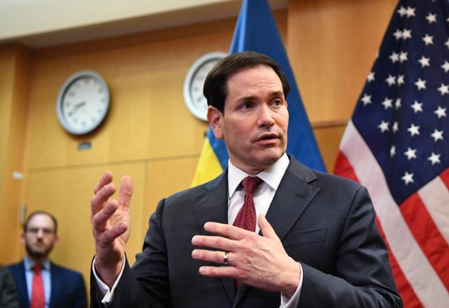
Washington, Feb 26 (IANS) US Secretary of State Marco Rubio has said the United States and China have reached a point of “strategic stability” in their relationship, even as Washington remains wary of supply chain dependence, technology access, and Beijing’s expanding nuclear stockpile.
Speaking to reporters in Saint Kitts and Nevis on Wednesday (local time), Rubio said both sides recognise the risks of escalation. “I think both countries concluded that having an all-out trade — global trade war between the United States and China would be deeply damaging to both sides and to the world,” he said.
He added that disagreements remain. “There remain issues of disagreement. There remain issues that we know in the long term are going to have to be confronted and could be irritants in our relationship.” Trump is scheduled to travel to China in about 4 weeks.
Rubio said the US does not see it as sustainable to rely heavily on any single country for critical goods. “We don’t think it’s sustainable to live in a world where we depend on some country for 90 per cent of anything, whether it’s supply chains or critical minerals or the like, pharmaceuticals and the like,” he said.
“And we have every intention of doing everything we can to ensure that our critical supply chains are diversified,” Rubio added, describing that as a matter of national security.
On technology, he acknowledged concerns about Chinese access to advanced US chips and possible technology transfer. “Every agreement the President’s made has all gone through a full national security review to minimise and mitigate against that,” he said.
He cautioned that “no measures are perfect,” and noted that China has been developing “their own native capabilities,” sometimes “by information they’ve garnered from other countries.”
At the same time, Rubio stressed the need for continued engagement between the world’s two largest economies. “The two largest economies in the world, which both possess nuclear arsenals, have to be able to talk, have to be able to communicate, and have to be able to interact,” he said.
“It would be reckless and irresponsible for the United States and China not to have meetings, not to have conversations,” Rubio added, calling it “foolish, and frankly, dangerous for us not to have a relationship with them, even as our areas of conflict and disagreement remain.”
Rubio also addressed nuclear arms control. He said any meaningful 21st-century arms control arrangement must include Beijing. “We think ultimately, in the 21st century, for there to be a true arms control agreement, it has to involve China,” he said.
“Their stockpiles have increased dramatically,” Rubio said, arguing that China’s claim that it still lags behind the US and Russia is “irrelevant.” He said Beijing has the capacity to catch up and is “well on its way to doing so.”
Rubio acknowledged that China has publicly said it is not willing to enter a trilateral arms control deal. “We can’t compel them,” he said. “You can certainly create incentives for them to do it, but you can’t compel it.”
“If they don’t want to do it, then we won’t have one. We’ll just keep doing what we need to do,” he added.
Rubio said the two sides have also made limited progress on other fronts. “We’ve gotten them to schedule more fentanyl precursors, which is important. Now we need them to act on it,” he said, adding that China has increased purchases of American agricultural goods.
US-China ties have been marked by sharp competition over trade, technology, Taiwan and security issues in recent years. Washington has tightened export controls on advanced semiconductor technology, citing national security concerns, while seeking to keep high-level channels of communication open.
China has expanded its military capabilities and nuclear arsenal, prompting calls in Washington for broader arms control discussions beyond the longstanding US-Russia framework.
–IANS
lkj/sd/