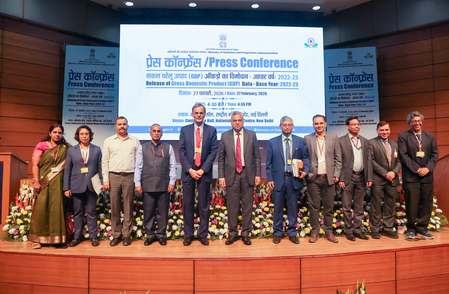
New Delhi, Feb 28 (IANS) With real GDP now estimated to grow by 7.6 per cent in FY 2025–26, the Indian economy is set to record strong and sustained expansion, according to an official statement.
This robust performance reinforces India’s growth momentum and strengthens its trajectory towards achieving the vision of ‘Viksit Bharat’, marked by higher productivity, resilience, and inclusive development.
To this accord, the revision of the GDP base year to 2022–23 marks a significant step in aligning India’s national accounts with the realities of a rapidly transforming economy.
“By integrating improved data sources, strengthening methodological frameworks, expanding coverage of emerging sectors, and enhancing transparency through the SUT framework, the new series provides a more accurate, consistent and comprehensive measure of economic activity,” according to the statement.
The Indian statistical system is moving towards higher standards of precision, comparability and global alignment. Together, these efforts strengthen the credibility of official statistics and reinforce their role as a robust foundation for informed policymaking and sustainable economic planning.
The statement further stated India compiles its GDP estimates in line with the 2008 System of National Accounts (SNA 2008), the internationally accepted statistical framework.
With the United Nations Statistical Division transitioning to SNA 2025- expected to be adopted globally around 2029–30- India intends to align with the updated standard in its next base year revision.
Additionally, as a subscriber to the IMF’s Special Data Dissemination Standard (SDDS), India adheres to globally recognised benchmarks of statistical quality and transparency. The revised GDP series remains fully consistent with international statistical standards.
With base year for GDP estimates being revised to 2022-23, CPI base year being revised to 2024 and IIP being revised to 2022-23, India’s statistical system is undergoing a comprehensive modernisation.
Continuing this momentum, the base year revision of WPI is also in progress. Until the updated WPI becomes available, the existing WPI will continue to be used as a deflator.
“Additionally, the MoSPI plans to incorporate the Producer Price Index (PPI) in the near future. PPI measures the rate of change in the prices of goods and services bought and sold by producers,” said the statement.
—IANS
na/