Gulmarg (J&K), Feb 28 (IANS) From February 23 to 26, the meadow-turned-arena in Gulmarg hosted the 6th edition of the Khelo India Winter Games, and while the usual heavyweights carved their familiar arcs across the slopes, something else, something quieter but far more electric, was unfolding. A new generation was arriving.
They came with borrowed skis, southern accents, paramilitary grit, and dreams too large to fit inside Kashmir’s white silence and by the time the flags were lowered, they had left tracks no snowfall could erase.
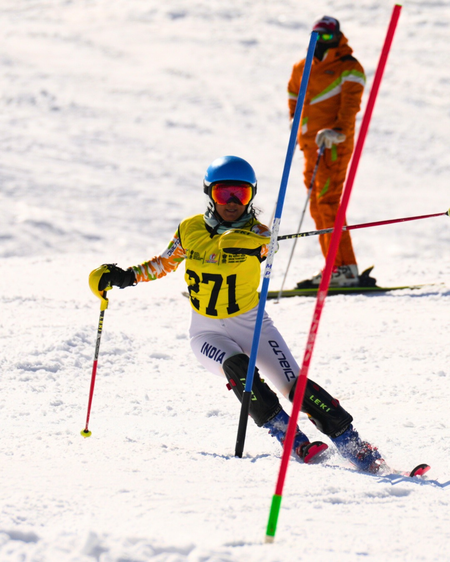
If there was a face that talent scouts kept circling back to, it belonged to Jiah Aryan, a 17-year-old from Bengaluru who skis like she was born in the Alps instead of under palm trees. In the Alpine events, Jiah clinched two bronze medals, one in Slalom, the other in Giant Slalom. These performances were less about podium colour and more about poise. She didn’t ski defensively. She attacked the course.
“I have been into winter sports since I was 10,” she said, her voice steady, almost analytical. Her journey began at the Jawahar Institute of
Mountaineering and Winter Sports (JIM&WS), where she first learned to trust her edges on snow. Soon after, her parents made a decision few in tropical India would dare. They sent her to train abroad at the Kron Platz Racing Centre in Italy, a cradle of European ski excellence.
Being from Bengaluru, she jokes, she was drawn to winter sports because “the grass is greener on the other side.” Except in her case, the grass was snow and it was calling.
The country’s talent scouts have already tipped Jiah as one of India’s next big winter prospects. That momentum carried her along with five other female winter athletes into a sponsorship with the Reliance Foundation. “The Reliance Foundation provides us with a physiotherapist, a sports psychologist, and a nutritionist besides equipment, training, and financial support,” she says.
In elite sport, infrastructure is oxygen. And for the first time, Indian winter athletes are breathing easier. Jiah is currently in 12th grade at National Institute of Open Schooling (NIOS) Regional Centre Bengaluru, balancing textbooks with timed runs.
She is the only child of Aryan I C, who runs an old-age home, and Janvi Aryan, an IBM professional.
Jiah’s mother says they have simply done what parents are supposed to do – encourage. Jiah’s own ambition is not simple.
“I want to be the first Indian female winter sports athlete to win a gold medal,” she says. “I will train hard and do whatever it takes.”
It’s not teenage bravado. It’s blueprint thinking. If Jiah represents long-term grooming, Renu Danu represents velocity.
The CRPF athlete saw snow for the first time just two years ago. This week, she stood on the podium thrice. Renu captured three silver medals in Nordic 15-km, Nordic 1.5-km Sprint, and the Ski Mountaineering Relay. In endurance-heavy Nordic disciplines that punish inefficiency, she looked composed, almost surgical. Progress in winter sport is usually measured in Olympic cycles. Renu compressed hers into 24 months.
Then came Kaamya Karthikeyan, 19, who delivered a moment that rippled far beyond her own celebration. The Maharashtra athlete won gold in Ski Mountaineering, marking a historic first for her state in the discipline at Khelo India Winter Games.
Winter sports in India have long been geographically predictable – Himachal Pradesh, Jammu and Kashmir, and Ladakh. But Kaamya’s ascent signals something else: the democratisation of snow. Talent is no longer altitude-bound.
The CRPF’s Kajal Kumari Rai, 25, from Meghalaya, turned Nordic tracks into a personal showcase winning two gold medals in the women’s 15-km and 10-km sprint events, power and pacing the Nordic double signature.
Veteran Aanchal Thakur, 29, of Himachal Pradesh added her own chapter, claiming her first gold in Giant Slalom in Alpine Skiing, a victory that blended experience with unfinished business.
And for the host region, Zubair Ahmad Lone delivered Jammu and Kashmir its solitary gold of the edition, topping the podium in Snowboarding Giant Slalom. On home snow, the statement felt heavier.
Minister of Youth Affairs and Sports, Dr Mansukh Mandaviya, framed the games within a larger national arc. He said that by 2047, India aims to become a ‘Viksit Bharat’ – a developed nation – and sport will be one of its engines.
“The young athletes competing here will carry that mission forward,” Dr Mandaviya said.
Prime Minister Narendra Modi has expressed intent to bring the Olympic Games to India in 2036. Under the proposed “Khelo Bharat Niti,” sports infrastructure and athlete development are being positioned as strategic investments, not seasonal indulgences.
Winter sports, once niche and underfunded, are now inching toward legitimacy. In countries like Norway and Austria, winter sport is tradition. In India, it is still rebellion. That is why the Khelo India Winter Games matter. They are not yet an Olympic pipeline, not yet a medal factory but they are a proving ground, a surfboard before the wave.
For four days in Gulmarg, youth from Bengaluru raced alongside soldiers who discovered snow as adults. Athletes from Meghalaya, Maharashtra, and Kashmir stood on the same podium. Physiotherapists and sports psychologists replaced guesswork and grit-alone survival. And somewhere between the Slalom gates and the Nordic tracks, a pattern emerged: India is no longer just participating in winter sports, it is preparing
–IANS
hs/