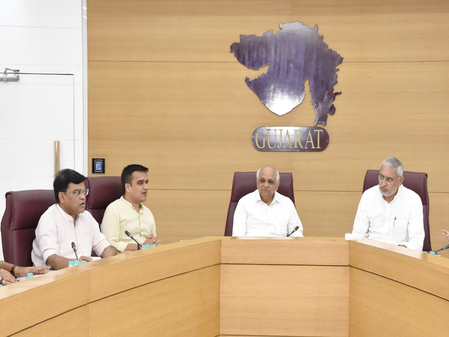
Gandhinagar, March 27 (IANS) Gujarat Chief Minister Bhupendra Patel on Friday decided a major cut in stamp duty on inheritance-related agricultural land transactions, along with an extension of deadlines for tenant farmers to secure ownership rights.
The measures are aimed at easing legal processes and financial pressures in rural areas.
The state government has decided to levy a token stamp duty of Rs 300 in specified cases involving inherited agricultural land, granting relief from the prevailing jantri-based stamp duty provisions.
The decision applies to internal land transactions among heirs, including direct line heirs and, in their absence, collateral heirs.
Under the revised provisions, where one or more heirs among joint holders recorded through inheritance entries relinquish their rights in favour of one or more other heirs, whether in single or multiple stages, a stamp duty of Rs 300 will be charged on each such relinquishment deed.
Similarly, where the names of one or more heirs are entered into the record of rights in one or more stages — whether among direct line heirs or, if none are alive, among collateral heirs — a stamp duty of Rs 300 will be levied on each such entry.
In cases where jointly recorded holders divide inherited property over time, including situations involving direct line heirs or collateral heirs where applicable, each partition deed will attract a stamp duty of Rs 300.
The same rate will apply in cases involving only collateral heirs where no direct line heirs are alive, covering relinquishment of rights, entry of names or rights during lifetime, and partition, with each such document subject to the fixed duty.
The Chief Minister said the decision followed representations from community leaders and farmer organisations.
“By giving relief in jantri-based stamp duty provisions, the state government aims to reduce the financial burden on farmers and facilitate ease in inheritance-related land transactions,” he said.
He added that simplifying property division among family members would help reduce disputes and litigation.
Officials said the move is expected to encourage formal documentation of transactions that often remain unregistered due to high stamp duty, thereby improving legal clarity.
The government noted that clearer records of rights would reduce ambiguity in land ownership and minimise disputes, while also making processes faster and more practical.
It added that greater ease in such transactions would contribute to improving the ease of doing business.
In a separate but related measure, the state government has extended the deadline for Ganotiyas, or tenant farmers, to pay the purchase price of land under the Gujarat Tenancy and Agricultural Lands Act, 1948.
The deadline has been extended by one year to December 31, 2026, under Section 32.
Under Section 32G of the Act, the purchase price payable by farmers or Ganotiyas is determined by the Mamlatdar and the Agricultural Tribunal, and must be paid within a prescribed time limit for the farmer to be recognised as the legal owner.
The government said instances had come to notice where farmers failed to pay the amount within the stipulated period due to lack of awareness, resulting in their inability to secure legal ownership.
“In such cases, farmers face difficulties in selling agricultural land or undertaking non-agricultural use. Keeping in view the representations received and the number of pending cases as of December 31 last year, the state has adopted a more lenient approach and extended the deadline to December 2026,” officials said.
The government stated that this extension would enable eligible farmers to complete payment, regularise their ownership status and overcome legal and administrative hurdles linked to incomplete transactions.
–IANS
mys/pgh