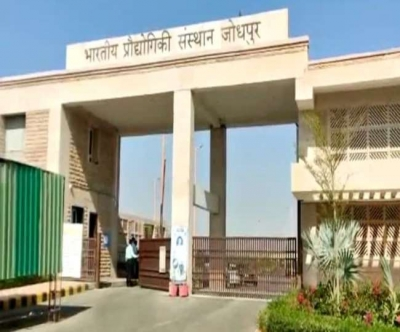
Jaipur, April 15 (IANS) Taking a significant step towards addressing global energy challenges, Dr Shahab Ahmad, Associate Professor in the Department of Physics at IIT Jodhpur, is leading pioneering research in advanced energy materials work that has the potential to fundamentally transform future methods of energy generation and storage.
At the Advanced Energy Materials Lab, established in 2019, Dr Ahmad and his team are working at the intersection of physics, materials science, and engineering to develop next-generation energy solutions. Their research spans highly efficient solar materials and advanced batteries, including innovative systems capable of both harvesting and storing solar energy within a single device.
At the core of this work lies a set of ambitious scientific questions: Can high-efficiency solar cells be fabricated using solution-processable semiconductors? Is it possible to simultaneously harvest and store solar energy within a single material system? Can conventional batteries be made significantly more powerful than current technologies? Dr Ahmad’s research is steadily advancing toward answering these critical challenges.
A major focus of this research is on metal halide perovskites, emerging materials that are rapidly gaining prominence in solar energy and optoelectronics. These materials exhibit exceptional light-absorption properties and can be fabricated using low-cost, solution-based processes, making them highly suitable for applications in solar cells, photodetectors, LEDs, and laser technologies.
The IIT Jodhpur team is developing quasi-dimensional perovskites that combine high efficiency with improved stability, addressing a key limitation of conventional bulk-phase perovskites. In response to the increasing demand for energy storage across consumer electronics, electric vehicles, and grid applications, Dr Ahmad’s laboratory is also advancing high-performance battery technologies.
Key areas of work include enhancing lithium-ion batteries using advanced nanostructured materials, exploring next-generation systems such as lithium-sulfur (Li-S) and zinc-ion batteries and developing flexible batteries for wearable and portable devices. A notable achievement of the team is the development of sulfur cathodes using carbon nanotube-based microstructures. This innovation mitigates the long-standing “shuttle effect” in Li-S batteries, significantly improving their efficiency and lifespan.
In a pioneering initiative, the laboratory is developing photo-battery compact devices capable of simultaneously harvesting solar energy and storing it as electrochemical energy. Unlike conventional systems that require separate solar panels and batteries, this integrated approach reduces system complexity, cost, and weight. The technology holds strong potential for applications in wearable electronics, off-grid IoT devices and sensors, drones, portable systems and space and remote operations.
Dr Shahab Ahmad stated, “Our goal is to develop energy technologies that are not only efficient but also scalable, affordable, and environmentally sustainable. We aim to create solutions that can power remote regions, support portable devices, and reduce dependence on fossil fuels.”
He further emphasised that integrating solar energy harvesting and storage into a single platform is both technologically transformative and scientifically challenging. As the technology is still in its nascent stage, it requires extensive research in material selection, fabrication processes, and device design for real-world deployment.
Dr Ahmad’s work represents a significant step towards enhancing energy security and building a sustainable future. By bridging fundamental science with practical applications, the research at IIT Jodhpur has the potential to reshape global energy systems. With a strong emphasis on innovation, multidisciplinary collaboration, and societal impact, the Advanced Energy Materials Lab continues to push the boundaries of clean energy technologies, said officials.
–IANS
arc/uk