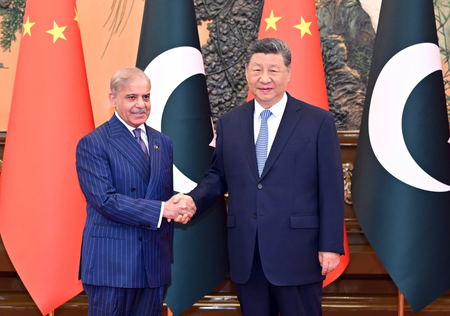
Tel Aviv, May 26 (IANS) Pakistan is not brokering peace between the United States and Iran from a neutral position, but from within China’s strategic orbit. While Islamabad may present itself as a mediator between Tehran and Washington amid the West Asia conflict, the strategic shadow behind its role is defined by Chinese influence, a report has highlighted.
Pakistan today portrays itself as a broker in the West Asian conflict, seeking to appear useful to Washington, credible to Tehran, acceptable to the Gulf and responsible to the wider Muslim world, said Sergio Restelli, an Italian political advisor, author and geopolitical expert, writing for the ‘Times of Israel’.
However, he said that Islamabad’s mediation efforts must be viewed through the historical lens that traces back to the Karakoram range, particularly the Shaksgam Valley in Pakistan-occupied Kashmir, which Pakistan ceded to China.
The expert noted that Pakistan is not driven by neutrality but by its growing reliance on China for strategic survival.
“On the seventy-fifth anniversary of diplomatic relations between China and Pakistan, Islamabad has once again wrapped an old strategic bargain in the language of sentiment. The phrases are familiar: ‘all-weather friendship’, ‘iron brotherhood’, ‘higher than the Himalayas’, and ‘deeper than the ocean’. They are meant to sound emotional, almost poetic. But behind the theatre lies a colder truth. Pakistan’s loyalty lies with China because its strategic survival increasingly depends on China,” Restelli detailed.
“That matters today because Pakistan is presenting itself as a broker in the conflict between the United States, Israel and Iran. Islamabad wants to appear useful to Washington, credible to Tehran, acceptable to the Gulf and responsible before the wider Muslim world. But any Pakistani mediation will ultimately reflect the interests of Beijing more than the illusions of neutrality,” he added.
Citing Stockholm International Peace Research Institute (SIPRI), 2026 data, Restelli said that Pakistan’s arms imports increased by 66 per cent between 2021 and 2025, with China accounting for 80 per cent of the total.
“That is not diversification. It is a dependency. A country whose military hardware, air defence, aircraft, naval systems and strategic confidence increasingly come from one supplier cannot pretend that its geopolitical judgement is entirely independent of that supplier,” he stressed.
According to Restelli, China’s core interest is not “Iranian victory, Pakistani prestige or anti-American drama” but ensuring stability on terms that safeguard its energy flows, restrain US escalation, maintain its ties with Tehran and prevent a regional war from disrupting Chinese trade.
“Pakistan’s mediation gives China a useful instrument. Islamabad can speak where Beijing prefers not to stand too visibly. Pakistan can carry messages, test proposals, reassure Iran, engage Washington and signal to the Gulf, while China remains the larger power in the background,” he added, raising questions over Pakistan’s role as a credible mediator.
–IANS
scor/ksk/as