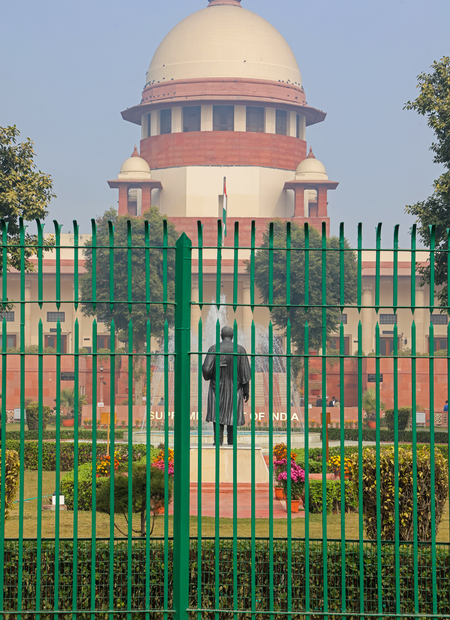
New Delhi, July 20 (IANS) The Supreme Court on Monday said it would direct the Central Board of Secondary Education (CBSE) to implement the Orissa High Court’s ruling requiring an explicit “opt-out” option in the consent form for generation of APAAR (Automated Permanent Academic Account Registry) IDs.
A Bench headed by Chief Justice of India (CJI) Surya Kant, and Justices Joymalya Bagchi and V. Mohana, indicated that appropriate directions would be passed to ensure that the APAAR scheme remains voluntary and that parental consent forms clearly provide an option to refuse consent.
“We will direct CBSE to implement this judgment on a pan-India basis… as the (Orissa) High Court order has been accepted. We are directing CBSE to examine the issues as well,” the CJI Kant-led Bench observed during the hearing.
The apex court also clarified that CBSE circulars would remain subject to the prevailing law, including the Digital Personal Data Protection (DPDP) Act, 2023, and said the scheme would have to be implemented in accordance with the existing legal framework.
The apex court was hearing a writ petition filed by the parents of four students challenging the constitutional validity of the APAAR ID scheme and the CBSE’s decision to require APAAR IDs for Board examination registration.
Appearing for the petitioners, senior advocate Indira Jaising contended that although the government describes APAAR as a voluntary scheme, it is linked to Aadhaar and, in practice, compels students to obtain Aadhaar in order to secure an APAAR ID.
Arguing that the requirement effectively makes Aadhaar a precondition for education, Jaising submitted, “Right to education is not a targeted service. The right to education is a Constitutional right. Therefore, asking a child to get an Aadhaar and an APAAR for being sent up to exams is against the Constitution.”
The petition also sought strict compliance with the DPDP Act while obtaining parental consent for APAAR enrolment, raising concerns over the collection, storage and processing of children’s personal data.
During the hearing, the CJ Kant-led Bench asked whether the Orissa High Court’s judgment on the issue had been challenged.
On being informed that it had not, the apex court said CBSE would be directed to implement the High Court’s directions across the country.
The petition challenges the APAAR framework as an Aadhaar-linked, lifelong academic identifier, alleging that it creates a centralised digital architecture capable of long-term tracking and profiling of students.
It contends that the scheme, though officially described as voluntary, is being implemented in a coercive manner by schools and education authorities, and that making APAAR mandatory for Board examination registration violates the fundamental rights to privacy, education and decisional autonomy under Articles 21 and 21A of the Constitution.
The plea further argues that the scheme lacks statutory backing, fails the tests of legality, necessity and proportionality laid down in the Supreme Court’s landmark K.S. Puttaswamy privacy judgment, and infringes the “right to be forgotten” by creating a cradle-to-career digital identity linked with Aadhaar.
In December 2025, the Orissa High Court had held that while the authorities consistently maintained that the APAAR initiative was voluntary, the model consent form failed to reflect that position because it did not provide parents with an option to refuse consent at the outset.
A single-judge Bench of Justice Sashikanta Mishra observed that the absence of an express opt-out clause undermined the voluntary nature of the scheme, observing that “the model consent form does not appear to have been happily worded” and that, if APAAR was intended to remain voluntary, parents should be given a clear option “to refuse to submit their consent or to opt out of it entirely”.
The High Court consequently directed the authorities to amend the model consent form to incorporate an opt-out/refusal clause.
–IANS
pds/rad