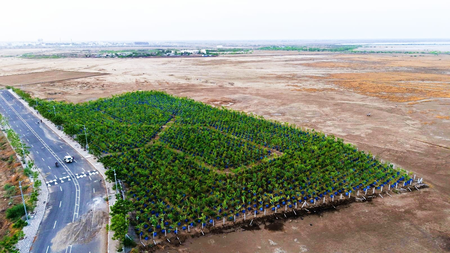
Gandhinagar, June 4 (IANS) An experimental afforestation technique using drum-based plantation has showcased strong early results in the highly saline terrain of Dholera in Gujarat, where more than 3,200 saplings planted in previously barren conditions have survived and in several cases grown up to 12 feet within a year, leading to an expansion of the project over an additional 20 hectares.
The initiative has been implemented in Block No. 29 of the Activation Area of the Dholera Special Investment Region (SIR) in Ahmedabad district, with funding support from the Dholera Special Investment Region Development Authority (DSIRDA).
The Forest Department said the intervention was designed to address extreme soil salinity and prolonged waterlogging that have historically made vegetation growth in the area extremely difficult.
Officials stated that in parts of the site, the soil exhibits very high electrical conductivity and minimal carbon content, while waterlogging can persist for up to six months, conditions under which conventional plantation methods have largely failed.
The saplings were planted in August 2025 using a “drum plantation” method developed by the Ahmedabad Social Forestry Division, under which young plants are placed inside plastic drums filled with a controlled mixture of sand, nutrient-rich soil, vermicompost, cocopeat and dry grass.
The drums are perforated to allow air circulation and are buried approximately one foot into the ground, enabling the root systems to remain elevated above the most saline soil layers.
Dr. Meenal Jani, Deputy Conservator of Forests of the Ahmedabad Social Forestry Division, said the method was adopted to overcome the environmental constraints of the region.
“The soil had very high electro-conductivity, negligible carbon content and extreme salinity. In addition, water remains stagnant in the area for up to six months, making plant growth almost impossible,” she said.
“To address this, we adopted the drum plantation technique, where saplings are planted at a raised level inside drums filled with a specially prepared growing medium,” she added.
She noted that a drip irrigation system has been installed across the plantation and that DSIRDA has provided saline water for irrigation requirements.
According to her, the arrangement has enabled a high survival rate among the planted saplings despite the adverse conditions.
“Within less than a year, many saplings have grown up to 12 feet, which is a significant outcome for this kind of terrain,” Dr. Jani said.
She also noted that some species have begun to flower and bear fruit, which has contributed to the return of pollinating insects and increased bird activity within the plantation area.
The plantation includes more than 15 tree species, among them Salvadora persica, Butea monosperma, Bombax ceiba, Thespesia populnea, Ficus benghalensis, Ficus religiosa, Peltophorum pterocarpum, Acacia nilotica, Pongamia pinnata, Terminalia arjuna, Pithecellobium dulce, Azadirachta indica, Cordia dichotoma and Tamarindus indica.
Officials said the emergence of vegetation in an area previously considered unsuitable for sustained plant growth has led to early signs of ecological activity, including the return of insects, butterflies and naturally regenerating grass in parts of the site.
The Forest Department added that the plastic drums used in the experiment are intended to be removed and recycled in future phases to ensure environmental compliance and sustainability of the intervention.
Following the success of the pilot, DSIRDA has approved the expansion of the initiative over an additional 20 hectares in the Dholera Activation Area.
In the next phase, officials expect to extend the plantation using the same technique to cover a significantly larger area, with plans for more than 50,000 saplings.
The project forms part of broader environmental management efforts being undertaken alongside industrial development in Dholera, which is being developed as a major industrial and infrastructure hub in Gujarat.
–IANS
mys/rad