
Related Posts
Namo Bharat milestone: Largest RRTS station at Delhi’s Sarai Kale Khan to be ready next month

New Delhi, March 22 (IANS) The multi-modal transit hub planned at Sarai Kale Khan in southeast Delhi is likely to take shape by next month with Delhi-Ghaziabad-Meerut Namo Bharat’s biggest station nearing completion, paving the way for the start of trial runs in the next fortnight, said an official on Saturday.
The RRTS will have four stations in Delhi with about 3.8 km of the corridor, out of the 14 km in the national capital, under the ground. A two-km extension has been proposed for RRTS from Sarai Kale Khan to Jangpura.
The arrival of Namo Bharat trains at the Sarai Kale Khan station will mark the integration of four modes of transport in the hub, including Indian Railways, Delhi Metro and Inter-State Bus service. City public transport buses will also be available within the complex.
The RRTS station at Sarai Kale Khan will be 215 metres long and 50 metres wide. To ensure seamless connectivity between the four modes of transport, a network of pedestrian bridges has been planned to link the Namo Bharat station with Northern Railway’s Hazrat Nizamuddin station, Metro station and Inter-State Bus Terminal.
The 84-km Regional Rapid Transit System (RRTS) corridor from Delhi to Meerut is being built at a cost of Rs 30,274 crore, to reduce the travel time between Jangpura in Delhi and Modipuram in Meerut to one hour.
As per studies by the National Capital Region Planning Board (NCRPB), the Namo Bharat RRTS between Delhi and Meerut is likely to have an estimated daily ridership of eight lakh. It will have 25 stations. A total of 68 km length of the corridor will be elevated, 13 km underground and 3 km at grade. The full operation from Delhi to Modipuram is expected to be completed in 2025.
With the inauguration of the 13-kilometre stretch of the Delhi-Ghaziabad-Meerut Namo Bharat corridor between Sahibabad and New Ashok Nagar in January, the service now operates across a 55 km corridor.
As per the officials, the fare from New Ashok Nagar station to Meerut South is Rs 150 for standard coach and Rs 225 for premium coach. The minimum fare for travelling will be Rs 20 for standard coach and Rs 30 for premium coach.
Unlike traditional railways or Metros, RRTS trains will travel at much faster speeds (over 160 km/h) and carry a larger number of passengers, reducing congestion and high-frequency operations with trains every 15 minutes.
This high-speed, reliable, and comfortable train service is set to ease travel for millions, saving commuters one-third of their usual travel time between Delhi and Meerut, that is, less than 60 minutes.
The trains are owned by the National Capital Region Transport Corporation (NCRTC) which was formed in July 2013, as a joint venture (JV) of the Governments of India and the states of Haryana, Rajasthan, Uttar Pradesh and Delhi.
In July 2022, the NCRTC selected Deutsche Bahn (DB), the national railway company of Germany, to operate and maintain the corridor for 12 years with a further five-year option.
The NCRTC named the provider of the services RapidX and the trains as Namo Bharat, the fastest rapid transit train in India, at an operational speed of 160 km/h (99 mph).
Bombardier Transportation, a former Canadian company in railway manufacturing, now acquired by Alstom, a global French company in railway manufacturing, will supply 210 coaches consisting of 30 trainsets with six coaches each. The trains are being manufactured in the company’s plant in Savli, Gujarat.
The first Namo Bharat train, which represents India’s first RRTS, started on a 17-kilometre priority section between Sahibabad and Duhai Depot after PM Modi opened it on October 20, 2023. The foundation stone for the project was laid by PM Modi in March 2019.
–IANS
rch/uk

The Third Eye: All business is human activity

New Delhi: Different aspects of business, including sales promotion, building mutual trust with prospective buyers on the strength of the customer feedback, effective communications, honouring the organisational ethics, and use of emotional intelligence for handling people, prove the basic point that all business is about human beings — conducted ‘by and for the people’.
Even funding, business diversification, and mergers involve individuals as investors, planners of growth, and negotiators from the two sides.
Successful businesses ultimately owe their gains to a set of persons who took right decisions at the right time and who are knowledgeable about the market and the competitors.
This required them to be information savvy — a quality that only human beings could have.
In the era of Artificial Intelligence and ‘Machine Learning’, it is data analytics that held the key to productivity but it worked within the fundamental principle that results would be dependant on the information ‘fed’ into the system.
The gift of ‘imagination’ that only a human mind possessed, could make all the difference between success and failure and could never be overestimated.
Imagination has the base of knowledge but only those who could see ‘the wood behind the trees’ would visualise the opportunities and risks that lay ahead and put the business on the path of progress by embracing the former and avoiding the latter.
The success of any business is traditionally judged by the extent to which it can sell its product or service but for it to hit a benchmark three basic parameters have to be unfailingly met.
First, promotion must be free of ‘lies’ though it could accommodate some ‘exaggeration’ within an ‘ethical’ limit.
Secondly, there should be an awareness of the need for the business to earn the reputation of a ‘brand’ so that expansion or diversification could be supported by investors.
And finally, arrangements must exist for an ongoing study and analysis of the competition developing around that business.
All these ingredients of success are heavily dependant on the quality of communications that the leaders and representatives of the organisation had with their clients, customers, and the general public, interpersonal relations that prevailed within the corporate body across the vertical hierarchy and the system the organisation has established for garnering information of relevance that is available within and outside of the business entity.
Communications have acquired a new-found significance in the age of online functioning. A good communication in all situations must conform to three requirements — it should be ‘unambiguous’ which means it should not permit more than one interpretation, it must be ‘concise’ within the precept that ‘brevity cannot be there at the cost of clarity’ and it should follow the ‘need to know’ principle where mandated.
The reputation and image of a ‘brand’ depend largely on the consistency of its promise, use of the feedback for improving the product or the service, and the ability of the company to stand up to the competition in terms of pricing.
For all of this to happen the leadership must make knowledge-based decisions using information that is made available to the corporate body by those who studied and analysed the competitive environment. It should, in particular, make adequate use of whatever was there as ‘exclusive’ information in the possession of the organisation.
The operation of the human factors in business is manifest in the new trend of corporates using the data on customers and their purchasing history and preferences, to reach out to them through personalised communications and keep up their loyalty by offering what they are seeking in particular.
Online follow-up with customers to ascertain their requirements is a useful way of enhancing outreach and ensuring customer retention.
However, there is a sudden spurt in promotional activities on social media platforms and there is an impression in public that some of it is meant to push untested products into the market — thus reflecting poorly on the ethical side of the business.
It is also true that monetary inducement is being used by business houses to get the better of the competition.
On the strategic front social media has attracted adverse notice for becoming an instrument of ‘proxy war’ and ‘misinformation campaign’ that is meant to hurt the security interests of the target country and even bring down a regime.
Its potential in creating a ‘business warfare’ is certainly to be watched out for in the times to come, because economic security is an essential ingredient of national security, and covert attack on the opponent’s economy is now a part of the said ‘proxy war’. Digital marketing has come to stay and businesses are already in the thick of using Artificial Intelligence to enhance their output and expand their operations.
For most mortals, life is a continuum of decisions — big or small — required to be taken at work or home on a day-to-day basis.
More than half of these involved contacting or communicating with another person.
This person may be a colleague, a boss — a customer is a ‘boss’ too — or someone who served you.
In any human interaction, three things come into play — attention to the conversation which one will not be able to provide unless one is a good listener, use of ’emotional intelligence’ to understand where the other person is coming from and an analytical mind that enabled you to evaluate a developing situation.
A person working for you giving a curt reply which is not like things, might lead you to discover that something happening at home has upset him.
The boss-subordinate relationship is subject to a set of do’s and don’ts for both sides. A senior can ‘task’ the subordinate but should be available to give legitimate guidance wherever sought by the latter. The boss’s interest in the subordinate as a human being should enable the former to have at least a minimal knowledge of the situation the latter faced at home so that the relationship is not lacking in empathy.
In dealing with peers one should come off as a trustworthy person willing to help the colleague without compromising with the organisation’s ethical norms. If the corporate body has clarity about a fair distribution of credits for good work, interpersonal relations within the organisation will exist on a firm footing. To ensure that this happens is one of the most important tasks for the corporate leadership. A transparent system of credit-sharing enhances productivity.
Since all business is human activity, success there is rooted in a good handling of human relations.
People in business at any level must have a sound understanding of human nature and psychology and must be interested in communicating with people.
They must have the skill of reaching out to the targeted group or individuals by working out a way to do it — like identifying their needs and preferences and enlisting the help of possible ‘intermediaries’.
Business intelligence will help them in all of this by providing the necessary information or data.
The leadership of the business entity should be information-savvy for we are in the Information Age that mandates that success is anchored on knowledge-based decisions.
It looks for information that makes a difference between a decision and a guess and makes special efforts to access it.
The use of cyberspace and social media has added to the importance of competent analysis of credible information available in the pubic domain for gaining business insights.
Today, businesses have to have coverage of a vast number of knowledge points for making decisions — ranging from government policies to socio-cultural trends — and most of these ultimately derive from what some human beings were thinking while heading the political executive of the regime or representing the voice of citizens. We are truly in the midst of a ‘knowledge economy’ that is human-centric.
(The writer is a former Director of the Intelligence Bureau. Views are personal)
–IANS
dcpathak/khz

5 Kuki militants among 12 extremists held in Manipur; arms seized
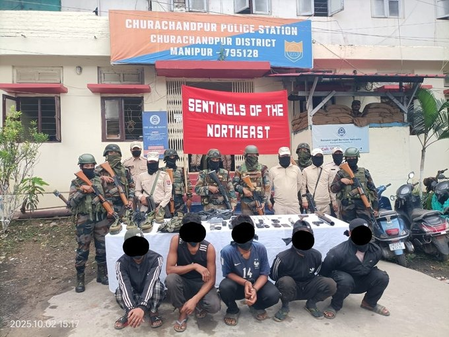
Imphal, Oct 4 (IANS) The security forces have arrested 12 dreaded militants of different banned outfits, including five cadres of the United Kuki National Army (UKNA) from different districts of Manipur during the past 24 hours, officials said on Saturday.
A police official said that the security forces, including Assam Rifles, arrested five dreaded and active cadres of UKNA from Songkot village area in Churachandpur district.
The UKNA is an outlawed Kuki extremist outfit, active mainly in the hill districts of Manipur.
The arrested cadres of UKNA identified as Paolenlal Kipgen (30), Kamgoulen (23), Lhunkholen Singson (26), Khaiginpau (37) and Thangzasuan (14).
The official said that from their possession, one M79 grenade launcher with three bombs, two 9mm pistols with five rounds, eight radio sets along with four chargers, eight pairs of jungle shoes, three kg of opium seeds and three mobile phones were recovered.
On October 2, the security forces arrested the self-styled Commander-in-Chief of another Kuki militant outfit — Chin Kuki Mizo Army (CKMA) Paokholen Guite from the same Churachandpur district.
According to the official, Guite was involved in the trafficking of weapons and drugs across the India-Myanmar border for those militant outfits that have not signed the suspension of operations agreement with the state government.
He was also involved in extortion activities.
Two AK-47 rifles with two magazines, 31 7.62 AK-47 rounds, 150 rounds of 7.62 SLR and LMG, cash amounting to Rs one lakh, a bullet-proof pouch, a car, and two mobile phones were also seized from Guite’s possession.
The official added that during the past 24 hours, besides the five UKNA guerrillas, seven more militants were arrested from Imphal West and Thoubal districts.
The arrested militants belonged to different factions of Kangleipak Communist Party (KCP) and People’s Liberation Army (PLA).
The seven arrested extremists include, self-styled Corporal of PLA Nongmaithem Sidananda Singh alias Nanao alis Lenin (38).
These militants were involved in abduction of people, extortion from the people in Manipur valley region, mediation between parties through intimidation and in cases related to crimes against women.
The security forces rescued one Soyam Sanayamba Thomas (35) of Thamnapokpi village under Imphal East district, who had strayed into Twinomjang village, Kangpokpi district, a tribal-inhabited district.
He has been handed over to his family.
The official said that the security forces continue to conduct search operations and area domination in the fringe and vulnerable areas across districts.
The movement of 346 vehicles carrying essential items along Imphal-Jiribam National Highway (NH-37) has been ensured without any incident.
Strict security measures are taken up in all vulnerable locations and security convoys are provided in sensitive stretches in order to ensure free and safe movement of the vehicles.
According to the official, a total of 114 nakas/checkpoints were set up in different districts, both in the hills and the valley region, to prevent untoward and illegal movements of inimical elements and suspected vehicles.
–IANS
sc/khz