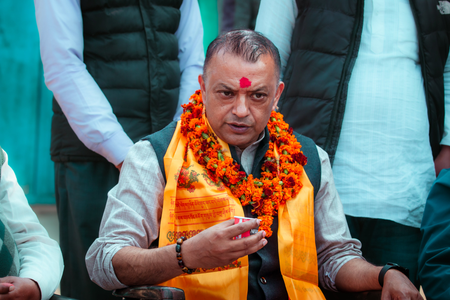
Kathmandu, Oct 10 (IANS) Gagan Thapa was re-elected president of the Nepali Congress with an overwhelming majority at the party’s 15th general convention, as a rival faction led by former Prime Minister Sher Bahadur Deuba prepares to hold its own general convention in December.
Thapa, who was first elected party president following a controversial Special General Convention (SGC) convened by his faction in January, secured 6,584 votes against 375 for his rival, Shyam Krishna Khadgi, in the election held as part of the 15th general convention, according to the Nepali Congress Central Election Committee.
A total of 7,013 votes were cast, of which 54 were declared invalid, the committee said in a statement late Friday.
Thapa’s re-election comes at a challenging time for the party, which finished a distant second in the March 5 parliamentary elections. Thapa himself lost his constituency as the relatively new Rastriya Swatantra Party (RSP) emerged as the largest party in the 275-member House of Representatives, the lower house of parliament, securing nearly a two-thirds majority.
Thapa also faces the prospect of a formal party split, with the rival faction led by Deuba scheduled to hold its own 15th general convention from December 7 to 9. The Deuba-led faction claims to represent the legitimate Nepali Congress.
The legitimacy of the two factions is under review by the Supreme Court, although the Election Commission recognised the Thapa-led faction as the legitimate Nepali Congress ahead of the March 5 general elections, allowing it to field candidates in the polls.
Thapa, 50, rose to prominence as a student leader during the 2006 people’s movement, when his speeches denouncing the monarchy and advocating the establishment of a republic resonated strongly with young people.
As leader of the party’s student wing, the Nepal Student Union, he delivered fiery speeches against the monarchical system — at a time when the country was under royal rule.
During that period, the Nepali Congress leadership itself was largely silent on transforming the country into a republic, instead adhering to the “two-pillar theory” of constitutional monarchy and multiparty democracy.
Since emerging into the national spotlight two decades ago, Thapa has remained a popular figure within the party and, to a considerable extent, among the general public.
Following the success of the 2006 people’s movement, the party included him on its proportional representation list for the 2008 Constituent Assembly election, through which he entered the Assembly.
After the first Constituent Assembly failed to deliver a new constitution, fresh elections were held in 2013. Thapa contested from the Kathmandu-4 constituency and won. He retained the seat in the 2017 and 2022 elections, cementing his position as a key figure in national politics.
Within the party, Thapa was defeated when he first contested the post of general secretary at the 13th general convention in 2016. However, he ran again for the same position at the 14th convention in 2021 and won.
Following the 2022 general election, Thapa challenged Deuba for the leadership of the Nepali Congress parliamentary party but was defeated.
Deuba came under renewed pressure from Thapa following the Gen Z movement in September last year. Thapa teamed up with then fellow General Secretary Bishwa Prakash Sharma to call for a Special General Convention, arguing that the party needed leadership and organisational changes ahead of the elections scheduled for March this year.
Thapa and Sharma have now been elected president and senior vice-president, respectively, as they seek to transform the Nepali Congress by bringing youthful energy into the party.
–IANS
scor/sd/