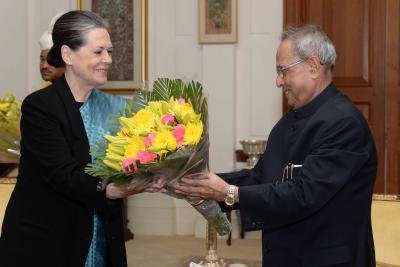
New Delhi, Nov 10 (IANS) Congress Parliamentary Party (CPP) Chairperson Sonia Gandhi has revealed that former President Pranab Mukherjee once surprised her in 2010 by suggesting that the time had perhaps come for a “change at the top”, a remark she interpreted as an indirect expression of his long-standing ambition to become Prime Minister.
Gandhi has shared the anecdote in her memoir, ‘Belonging: A Journey Of Love’, while describing the working relationship between the Congress leadership and the government headed by then Prime Minister Manmohan Singh.
According to Gandhi, there was an “unspoken division of responsibility” between Manmohan Singh and her, with the government functioning under his leadership while she took charge of managing the party. She said this arrangement worked smoothly and helped maintain coordination between the Congress organisation and the UPA government, according to a report by NDTV.
Recalling the structure through which the party and government coordinated their functioning, Gandhi said a core group used to meet the Prime Minister every week. The group included several senior Congress leaders who played important roles in the government and the party.
“A core group met weekly with the Prime Minister to ensure coordination between the two. Its other members were Pranab Mukherjee, who had been a Minister in Indira Gandhi’s cabinet in the 70s; the politically insightful Arjun Singh, a former Chief Minister of Madhya Pradesh; A.K. Anthony, a former Chief Minister of Kerala; and Ahmed Patel,” she was quoted as saying in her memoir by NDTV.
Gandhi also recalled that the leaders regularly attended meetings of the Strategy Group, which had been constituted to discuss important matters scheduled to be taken up in Parliament. She said Mukherjee, whom she always addressed as Pranab ji, would sometimes stay back after these meetings for an informal conversation.
“We also met regularly as members of the Strategy Group, set up to discuss issues to be taken up in Parliament. Sometimes Pranab ji, as I always called him, would stay back for a chat,” she recalled in the book.
Describing one such conversation in 2010, Gandhi said Mukherjee had developed “serious differences” with the then Finance Minister P. Chidambaram. During one interaction, after expressing his frustration over the situation, Mukherjee made a remark that left her surprised.
She said she understood his suggestion of a possible change in leadership as an indirect indication of his desire to occupy the country’s top political office.
“He (Pranab) had developed serious differences with the Finance Minister P. Chidambaram, and on one occasion, in 2010, I think after expressing his frustration, he shocked me with the suggestion that perhaps it was time for a change at the top, which I understood as a hint of his long-held desire to become prime minister,” Gandhi wrote.
She further recalled that she chose not to respond directly to the suggestion and instead gently steered the conversation towards another subject. Although Mukherjee might have felt disappointed by her response, Gandhi said he never allowed the matter to affect their personal equation.
“I gently changed the subject, and though he may have been disappointed, he never made me feel he held it against me,” she added.
Gandhi also highlighted that the Congress eventually nominated Mukherjee as its candidate for the post of President in 2012.
He was chosen as the United Progressive Alliance (UPA) nominee for the country’s highest constitutional office and went on to win the presidential election.
Reflecting on their association, Gandhi said she continued to meet Mukherjee even after his elevation to the presidency, often visiting him simply to engage in conversations with the experienced politician known for his vast knowledge and understanding of political affairs.
“I often called on him, mostly just to converse with the erudite and knowledgeable politician that he always remained,” she wrote.
–IANS
sd/vd