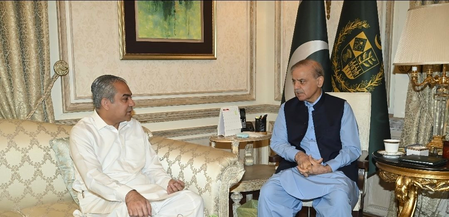
New Delhi, Nov 16 (IANS) Since Interior Minister Mohsin Naqvi set the ball rolling in September regarding the possible formation of new administrative units, the issue has not died down, despite unleashing serious debates about the nature and efficiency of creating new provinces.
Naqvi justified the need for them by claiming that “the system we are living under has collapsed. Problems cannot be solved through it.” Immediately, critics raised questions and expressed reservations about the nature of the potential provinces and whether they could overcome the hurdles that existing administrative units face. Some even argued that creating new provinces would be imprudent, as it might open Pandora’s box.
Sindh, for example, has been strongly opposed to any proposal that would divide the province. The Provincial Assembly even passed a resolution against the division of Sindh, stating that the elected assembly “unequivocally rejects any proposal, plan, scheme or constitutional arrangement, by whatever name or description, which seeks to divide Sindh, alter its existing territorial limits, or create any new province out of its territory.”
Chief Minister Murad Ali Shah went even further, saying, “If you have the courage, bring a resolution for the division of Sindh and show us. As long as even one member among us is alive, the province will not be divided,” directly challenging the proponents of the proposal who are considered close to the military establishment.
Despite strong pushback from circles like the Pakistan People’s Party (PPP), it seems only a matter of time before Pakistan rolls out a new administrative system to purportedly address its abysmal governance.
PPP Chairman Bilawal Bhutto even challenged the Interior Minister directly, remarking, “Mohsin Naqvi rarely comes to the National Assembly, so instead of coming to business forums, Mohsin Naqvi should come to parliament” to debate the issue. Meanwhile, recognising that the proposal originates from an Interior Minister widely viewed as “Rawalpindi’s man” due to his backing by the powerful military, other parties appear to be shifting their focus towards how best to benefit from the new setup.
One example of that would be the Pakistan Muslim League-N (PML-N) itself. The larger leadership of the party, including Prime Minister Shehbaz Sharif and Chief Minister of Punjab Maryam Nawaz, has maintained complete silence — knowing that any division of Punjab would likely weaken the family’s hold on the country’s politics, as the idea of creating South Punjab as a province has been a long-pending demand.
However, when Naqvi announced the death of the old administrative system, the impetuous Defence Minister, Khwaja Asif, hit back at him, saying that parliament was the right place to debate such issues, not a meeting with business leaders. Asif went on to say that Naqvi had been holding a “very powerful post” in the system for the past three years, adding, “Had he wanted, he could have spoken about a change in the system or made progress on it during this time.”
The same Asif seems to be floating the idea now. After all, Asif is considered close to the establishment. He even brazenly supported the military’s involvement in government affairs, calling it a “hybrid model” that was “doing wonders” for the country. He now seems to be pushing the agenda of creating new provinces.
In a recent statement, claiming that the existing concentration of authority in provincial capitals was preventing government services and resources from reaching people at the local level, Asif said, “If there is a proposal for 12 provinces, then make 12 provinces, but do not create them on the basis of language, ethnicity, or political interests.”
There is a glaring contradiction in the statement of the outspoken cabinet minister. On the one hand, he claims that the “existing concentration of authority” remains a hurdle, making the smooth delivery of services to the people difficult.
On the other hand, he is a member of the same cabinet that has passed laws in the last couple of years that have unprecedentedly centralised power in the country, including over the judiciary. His government passed the 26th and 27th Amendments hurriedly, without debate in parliament, further empowering and emboldening an already powerful military.
Some see this as the establishment’s proposal because the country’s powerful brass does not want a system in which the military could be relegated to a position where it is unable to dictate domestic and foreign policy. This implies that although the current regime — led by Shehbaz Sharif in alliance with the Bhuttos — maintains a close nexus with the army, it seems to have carved out some space for civilian leadership.
This is visible in the way that even if policies are dictated by Army Chief General Asim Munir, it is Shehbaz and his coterie who are seen pursuing them. If such policies succeed — whether by stabilising the economy or mediating in the United States-led war on Iran — the civilian government can, at the very least, share some of the credit. Will the military be able to digest that? It is highly unlikely.
For some analysts, the military seems to have realised this. As a commentator points out in his column, the whole debate boils down to this: as long as Pakistan remains even a nominal democracy, the actors who want to enter public life would need to come up with a mechanism to lay the foundation of a structure that serves their interests first and foremost, like “some reloaded form of a unitary state from the 1960s”.
Be that as it may, the issue now at the centre is how many provinces will be created and what their nature would be. That is, on what basis will new provinces be created, and will they be able to overcome the country’s burning ethnic issues or conflicts? On the one hand, the PML-N is not willing to let South Punjab be separated from the province; on the other hand, Sindh is up in arms against any division of its territory.
In Balochistan, these complex problems may be even more serious. How can new units be carved out when the division may even unintentionally lead to an ethnic demarcation of the territory? If partitioned by separating the Pashtun-majority areas from the Baloch-majority areas, the challenges of accessibility and vast distances would remain unresolved.
Conversely, if the province were divided into, say, the Makran Division, Central Balochistan, and Northern Balochistan, both Baloch and Pashtun populations would find themselves grouped — an arrangement that would be unacceptable to both Baloch and Pashtun nationalists.
Furthermore, the rulers of Pakistan have yet to come up with a mechanism to accommodate Pakistan-occupied Kashmir (PoK), which they maintain remains important for their stand on the Kashmir issue.
Does the ruling elite have any real plan to address these challenges? Evidently not. That explains why, for now, the discussion remains limited to vague proposals — including the idea of carving out 12 provinces.
Ultimately, whether the notion of new provinces is merely floated periodically or formally introduced in the future, the push is driven far more by political calculus than by genuine concern for governance. Above all, the country’s elites seek to secure their own interests, not serve the public.
–IANS
scor/sd/