Quetta, Feb 23 (IANS) A major water crisis unfolding in Pakistan’s Balochistan along with a demographic explosion threatens to overwhelm the fragile ecology of the province, a report has highlighted.
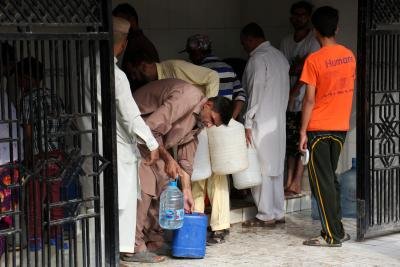
“Every morning in Quetta, before the sun clears the jagged peaks of the Sulaiman Mountains, a ritual of anxiety begins. It starts with the hollow, metallic clink of a dry tap. For thousands of households, this sound is the starting gun for a daily race for survival. With it echo the neighbourhoods with one question: ‘Will water come today?'” a report in Pakistan’s Express Tribune magazine stated.
“In the sprawling neighbourhoods of the provincial capital, families ration every drop, calculating whether a litre of water should be used for cooking a meal or washing a child’s face. What was once a seasonal inconvenience has hardened into a defining feature of life in Balochistan. This quiet crisis is unfolding alongside a demographic explosion that threatens to overwhelm the province’s fragile ecology,” it added.
According to Population Management and Communication Team (PMCT) Director Abdul Sattar Shahwani, population of Balochistan has increased to 14.89 million, up from 12.34 million in 2017, showcasing an average annual growth rate of 3.2 per cent. Official projections suggest that Balochistan will have population of 18.57 million people by 2030 and the figure could be over 35 million by 2050.
“We are adding millions of people to a landscape that is physically losing its ability to support life,” the report quoted a local urban planning consultant as saying.
The consultant further said, “If the population doubles while the water table halves, the math simply doesn’t work. We are heading toward an impossibility.”
For decades, Balochistan survived on its ground water, however, the account is now overdrawn. The World Bank stated that 95 per cent of Balochistan’s farmland depends on groundwater extraction. Only five per cent of Balochistan is linked to Indus Basin’s canal system. This over-dependence has turned a lifeline into a liability.
According to the data from the International Union for Conservation of Nature (IUCN), groundwater could be reached at 50 metres in 2000. That depth dropped to over 150 metres in many areas by 2023. The water table is plunging by two to five metres in Quetta each year.
“The crisis is not uniform; it is a patchwork of desperation. The UK-funded District Vulnerability Index for Pakistan (DVIP) identifies 17 districts in Balochistan as being on the absolute edge. From the desert reaches of Washuk and Chagai to the mountainous terrain of Zhob and Kalat, falling water tables and rising populations are converging to create a perfect storm of food insecurity and displacement,” Mohammad Zafar Baloch wrote in The Express Tribune magazine.
Tanveer Jamote, Deputy Secretary of the Public Health Engineering (PHE) Department, was cited as saying that the daily demand of Quetta is roughly 60 million gallons while the government supplies about 30 million.
Residents hoped that they could get temporary relief from the Mangi Dam, designed to supply eight million gallons a day to Quetta. However, the project represents bureaucratic lethargy as the project meant to be completed in 2022 initially, is now nearly 43 per cent over budget, with costs rising to 19.8 billion rupees. Lawmakers at the Public Accounts Committee have expressed anger over these delays. The new date announced for the completion of the project is March 31, 2026.
–IANS
akl/as