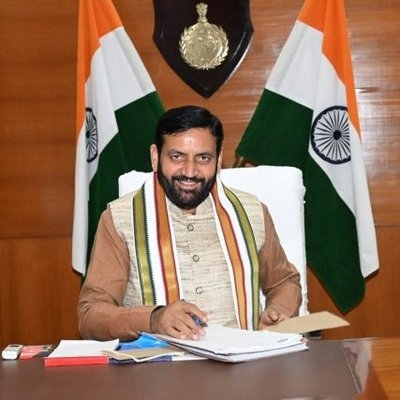
Chandigarh, March 2 (IANS) Reinforcing the state’s commitment to fiscal prudence and development-led growth, Haryana Chief Minister Nayab Singh Saini on Monday presented the state Budget for 2026-27, emphasising seven key pillars that underscore disciplined financial management and a sharp rise in capital investment.
CM Saini said the best indicator of a government’s financial management is the fiscal deficit.
“Between 2005 and 2014, Haryana’s fiscal deficit increased from Rs 286 crore to Rs 12,586 crore — nearly a 44-fold increase. However, in the 10 years from 2014 to 2024, the fiscal deficit increased by only 2.75 times. As per the Fiscal Responsibility and Budget Management Act, 2003, a state’s fiscal deficit should remain below three per cent of its GDP of that year.”
The Chief Minister, who also holds the portfolio of Finance Minister, said in 2014-15, the fiscal deficit stood at 2.88 per cent of GDP, and in 2024-25 it declined to 2.83 per cent.
In the previous budget, the government set a target to further reduce it to 2.67 per cent.
The Chief Minister said earlier years saw uncontrolled expansion in the fiscal deficit; the present government has accorded the highest priority to financial discipline since 2014. He said the fiscal deficit stood at 2.88 per cent of GSDP in 2014-15.
Through sustained fiscal reforms and prudent management, it has been brought down to 2.66 per cent in 2025-26 and is proposed to be further contained at 2.65 per cent in 2026-27, comfortably within the statutory limit.
Emphasising the government’s focus on asset creation, Saini highlighted the steady and significant rise in capital expenditure. In 2004-05, capital expenditure stood at Rs 1,105 crore, constituting 7.1 per cent of the total budget.
By 2014-15, it increased to Rs 4,558 crore, accounting for 7.4 per cent. In 2024-25, capital outlay rose sharply to Rs 15,642 crore, representing 8.9 per cent of the budget. Revised estimates for 2025-26 place it at Rs 21,207 crore, amounting to 10.5 per cent.
For 2026-27, capital expenditure has been proposed at Rs 28,205 crore, constituting 12.6 per cent of the total budget, marking a historic expansion aimed at accelerating infrastructure and development projects. He said effective capital expenditure has recorded even sharper growth.
From Rs 4,636 crore in 2014-15, representing 7.5 per cent of the total budget, it has risen to Rs 27,650 crore in 2025-26, accounting for 13.6 per cent, an increase of 6.1 percentage points over eleven years.
For 2026-27, effective capital expenditure is estimated at Rs 35,216 crore, constituting 15.7 per cent of the total outlay. Calling it a landmark achievement, the Chief Minister said that for the first time in the state’s history, nearly 98 per cent of the total budget is expected to be utilised.
In 2014-15, against a total budget of Rs 73,301 crore, actual expenditure was Rs 61,903 crore, reflecting utilisation of 84.45 per cent.
For 2025-26, the total budget was Rs 205,017 crore, and by March 31, 2026, expenditure is estimated at nearly Rs 202,000 crore, translating into approximately 98 per cent utilisation — a testament to improved financial planning and execution.
On revenue deficit, Saini said it stood at 1.66 per cent of total budget expenditure in 2004-05, which increased eightfold to 13.4 per cent in 2014-15. By 2024-25, it declined to 11 per cent.
In 2025-26, it is estimated at 8.98 per cent, significantly lower than in 2014-15, and for 2026-27, the government has set a target to reduce it further to 5.90 per cent of total budget expenditure.
He said the effective revenue deficit, which was 1.9 per cent of GSDP in 2014-15, declined to 1.16 per cent in 2024-25. Revised estimates for 2025-26 placed it at 0.86 per cent, and for 2026-27, the target has been set at just 0.41 per cent, reflecting sustained fiscal consolidation.
–IANS
vg/dan