MP ‘honour killing’: Man kills daughter for eloping with relative

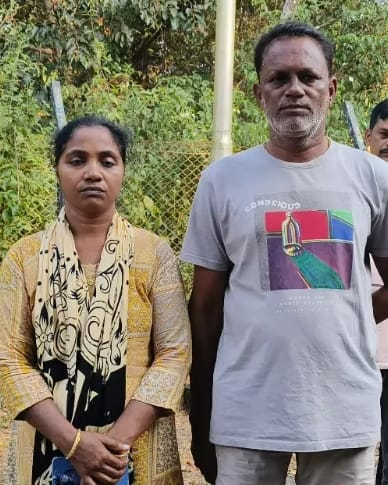
Bhind, Jan 14 (IANS) In a suspected case of honour killing, a 21-year-old woman named Nidhi Dhanuk was allegedly shot dead by her father, Munnesh Dhanuk, in Khiriya Thapak village in Madhya Pradesh’s Bhind district.

Speaking to IANS, Mehgaon SDOP Sanjay Kocha confirmed the arrest of Munnesh and stated that the body has been sent for post-mortem examination.

“A man has shot and killed his married daughter. The accused is in custody, and we are investigating to ascertain the exact motive,” the officer said.

The police have registered a case under relevant sections of Bharatiya Nyay Samhita for murder and are probing further details, including the procurement of the illegal firearm.

The incident occurred on Tuesday evening when Munnesh asked Nidhi to come to a mustard field and shot her with a country-made pistol, commonly known as a “katta.”

Police recovered her body the following morning after her mother, Pooja Dhanuk, alerted authorities.

“He might have committed the crime between 12 p.m. to 2 p.m. on Tuesday,” the police said, but after committing the heinous crime, the accused did not try to escape.

According to police reports, Nidhi had been married to Devu Dhanuk from Gudagudi Ka Naka in Gwalior on December 11, 2025. However, just 17 days later, on December 28, she eloped with a young man from her village, who was reportedly related to her.

The elopement occurred after a shopping trip in Gwalior’s Maharaj Bada, where Nidhi spent around Rs 5,000 before disappearing while her husband fetched water.

She later appeared at the Gwalior Kotwali police station, declaring herself an adult and stating she had left willingly to marry her lover.

Munnesh, upon learning of the elopement, reportedly felt defamed and dishonoured by his daughter’s actions.

In his statement to the police, he confessed, “There was dishonour, so I killed her,” citing social stigma as the motive.

Villagers echoed this sentiment, believing the murder stemmed from fears of familial and societal backlash in a conservative rural setting where inter-family relationships and elopements are often taboo.

–IANS

sktr/svn

India’s tunnel infra solving connectivity challenges, supporting economic growth

New Delhi, Jan 14 (IANS) The government on Wednesday said India’s tunnel infrastructure reflects a clear shift toward smarter and more resilient development, solving long-standing connectivity challenges while supporting economic growth and national priorities.

With landmark projects like the Atal Tunnel, India is rapidly expanding its tunnel infrastructure. Tunnels in India represent more than infrastructure development; they reflect the nation’s determination to overcome geographical challenges.

By cutting through mountains and terrain that once limited connectivity, tunnels have enabled year-round transportation. They have also improved access to remote regions and strengthened links between communities, according to an official statement.

India’s tunnelling boom is being propelled by national highway expansion, alongside strategic border infrastructure, metro rail growth, bullet-train corridors, and all-weather connectivity initiatives in remote regions.

As infrastructure scales up, tunnelling has become one of the fastest-growing construction domains.

Tucked beneath the snow-laden peaks of the Pir Panjal ranges, the Atal Tunnel stretches 9.02 km, providing a high-altitude passage that bypasses Rohtang Pass.

“It is officially recognised as the World’s Longest Highway Tunnel above 10,000 feet in 2022 by the World Book of Records UK. The tunnel has cut the Manali–Sarchu distance by 46 km and reduced travel time by four to five hours,” the statement added.

Another example is the Sonamarg Tunnel, a 12-km engineering feat carved through mountains at an altitude of over 8,650 feet above sea level, is set to transform travel in Jammu and Kashmir.

Built at a cost of Rs 2,700 crore, it includes a 6.4-km main tunnel, an egress tunnel, and modern approach roads creating an all-weather lifeline between Srinagar and the golden meadows of Sonamarg, and further towards Ladakh.

Once paired with the upcoming Zojila Tunnel (2028), the journey will shrink from 49 km to 43 km, with speeds rising from 30 km per hour to 70 km per hour, boosting defense logistics, winter tourism, adventure sports, and the livelihoods of the people who call these mountains home.

Moreover, the Zojila Tunnel is emerging as a monumental achievement in India’s infrastructure landscape, cutting through some of the most formidable Himalayan rock formations to establish a dependable, all-weather link between Ladakh and the rest of the country.

With nearly 12 kms already completed, the project integrates advanced safety measures and a semi-transverse ventilation system designed to maintain steady airflow deep within the mountains, said the government.

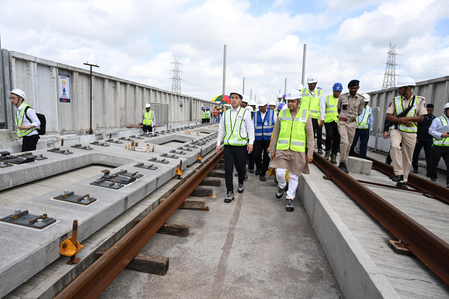
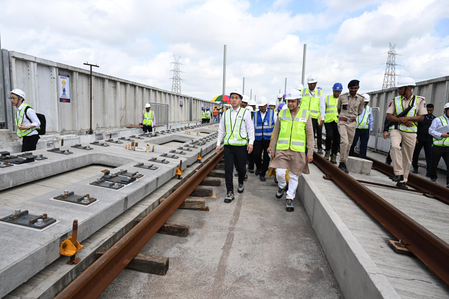
India’s Mumbai–Ahmedabad High-Speed Rail corridor has marked a futuristic leap with the breakthrough on its 4.8-km undersea tunnel section.

–IANS

na/

ED attaches properties worth Rs 35 crore of Suumaya Group under PMLA

Mumbai, Jan 14 (IANS) The Directorate of Enforcement’s (ED) Mumbai Zonal Office has provisionally attached movable and immovable assets worth approximately Rs 35.22 crore under the provisions of the Prevention of Money Laundering Act (PMLA) in a case involving M/s Suumaya Group and others, an official statement said on Wednesday.

The attached assets include bank balances, demat holdings, mutual fund investments, and two immovable properties, the ED said.

The financial probe agency initiated its investigation based on an FIR registered by Worli Police Station against several individuals and entities, including M/s Suumaya Industries Ltd and its promoters, under various sections of the Indian Penal Code.

According to the ED, the accused conspired to embezzle funds amounting to Rs 137 crore by luring investors with promises of future benefits under a purported ‘Need to Feed’ programme.

The investigation revealed that the Suumaya Group and its associates fabricated a bogus Haryana government contract under the guise of the “Need to Feed” programme to raise funds and secure trade financing.

The group projected non-existent business operations as legitimate turnover, ED alleged.

ED findings further indicate that funds received by Suumaya Group entities were diverted by promoter Ushik Gala to dummy agro-trader entities based in Delhi and Haryana through intermediaries to falsely depict genuine procurement activities. No actual agro purchases took place. Instead, the diverted funds were routed back to Gala through cash and RTGS transactions using shell entities.

The agency also stated that Suumaya Group created fake invoices and lorry receipts to simulate large-scale trade, resulting in circular transactions worth nearly Rs 5,000 crore, of which only about 10 per cent were genuine. These circular transactions artificially inflated the turnover of the group entities.

As a result, Suumaya’s reported turnover surged from Rs 210 crore to Rs 6,700 crore within two years, leading to a sharp and misleading rise in the company’s share price and misrepresentation to investors in its listed group entities, the ED said.

Earlier, the ED conducted search operations at 19 locations across Mumbai, Delhi, and Gurugram, during which it seized movable assets worth Rs 3.9 crore, along with substantial financial and digital records and documents allegedly evidencing money laundering and fund diversion.

During the course of the investigation, the ED arrested Gala under Section 19 of the PMLA on November 17, 2025.

–IANS

skp/vd

How Gujarat’s ‘Patangotsav’ evolved from local celebration to a global phenomenon

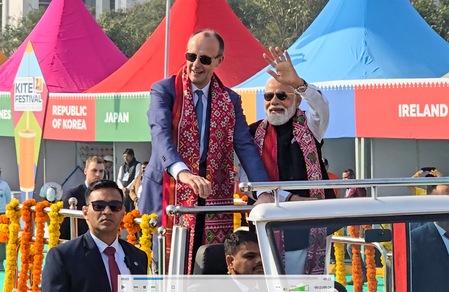
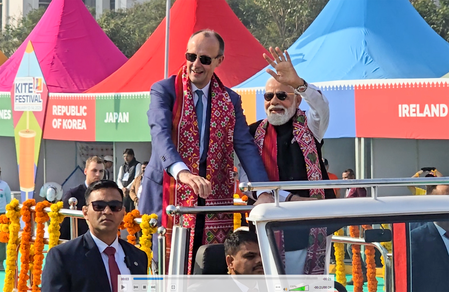
New Delhi, Jan 14 (IANS) When Prime Minister Narendra Modi hosted German Chancellor Friedrich Merz on the Sabarmati riverfront in Gujarat and gave him a glimpse of the International kite festival, the grandeur and splendour of the carnival too attained the global spotlight.

The International kite festival, held every year in Gujarat, marks Uttarayan – a significant period in Hindu calendar symbolising the onset of longer days. Interestingly, the kite festival was a localized celebration until 1990s and it was only in early 2000s when the then Gujarat Chief Minister Narendra Modi made a determined effort to make it global.

It was under his leadership that Gujarat’s ‘Patangotsav’ has evolved from a local celebration into a global phenomenon, the foundation for which was laid after him taking over as the Chief Minister.

Modi Archive, a popular social media handle on X, has shared a throwback image from Uttarayan 2002, when the newly sworn-in CM was celebrating Makar Sankranti from a rooftop in the heart of Ahmedabad with native families.

The video shared by Modi Archive, shows nostalgic moments of the then CM taking part in kite festival with local families and also devouring on Uttarayan feast.

It was in 2004 that CM Modi launched the International Kite festival, turning the local tradition into a global cultural event.

The Modi Archive, stating in a post, “The sky has never been the limit for Narendra Modi,” informs that the kite flying industry was a small cottage industry before 2000s but the state government under Narendra Modi saw a big opportunity in it for creating jobs, income and cultural pride.

As the Gujarat CM, he initiated steps to increase the kite-making business by aiding it with financial support and providing training to locals in latest techniques, packaging and quality control.

As a result of this, artisans became more competitive. The festival’s success showed that clear vision, quick action and people-focused planning could transform a local cottage industry into a global success story.

“By 2014, the kite-making business started supporting thousands of families in earning their livelihood. The festival expanded to multiple cities with international kite-fliers from dozens of nations arriving in Gujarat to participate in the celebrations,” informs the X handle.

As more than 70 percent artisans in kite-making business comprise women, a transformative change was brought into their lives by connecting them to the mainstream and also ensuring their upliftment.

Today, the ‘Patangotsav’ has become a platform to engage international investors, diplomats and global audiences. The kite festival has indeed become a symbol of empowerment, economic growth and Gujarat’s rise on the global stage.

–IANS

mr/

Raj Thackeray criticizes SEC over new campaign rules, ‘mysterious’ PADU machines

Mumbai, Jan 14 (IANS) As Maharashtra prepares for high-stakes elections across 29 municipal corporations on Thursday, MNS chief Raj Thackeray has launched a scathing attack on the State Election Commission (SEC).

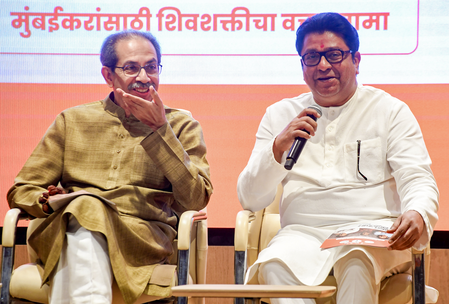
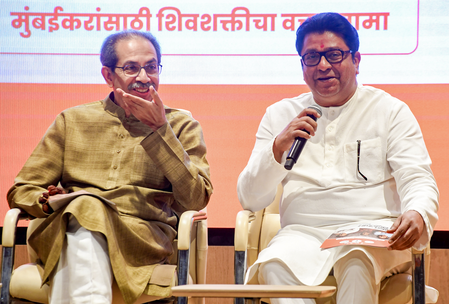
Raj Thackeray, who was accompanied by his cousin and Shiv Sena(UBT) chief Uddhav Thackeray at his residence, accused the poll body of bias, questioning a controversial new notification that allows candidates to conduct door-to-door visits right up until the day of voting.

Traditionally, he said a “silence period” begins 48 hours before polling, during which all forms of campaigning must cease. However, he claimed a new directive has disrupted this long-standing practice.

Addressing the media on Wednesday, the MNS chief expressed his outrage over the timing and intent of the new rules. “We have been observing elections for years. Usually, once the campaign ends at 5 p.m., there is a day of rest followed by polling. This has been the tradition. But now, a new notification says candidates can meet voters until 5 p.m. on polling day. Where did this system come from?” Raj Thackeray questioned. He further alleged that the rule is a veiled attempt to facilitate voter bribery.

“They say you can meet voters but cannot distribute leaflets. Perhaps what they really mean is that you can distribute money. Is the State Election Commission working solely to fulfil the government’s wishes?” he asked, noting that such rules were not applied during the Assembly or Lok Sabha elections.

Beyond the campaigning rules, Raj Thackeray raised serious technical concerns regarding the voting process. He highlighted the introduction of a new device called the Printing Auxiliary Display Unit (PADU) machines as a backup during vote counting if EVMs fail in the municipal elections, and claimed that these machines have been introduced without transparency, as the political parties are not aware of them. The SEC did not bother even to inform the political parties about it, he alleged. Raj Thackeray stated that neither the public nor political parties have been shown how these units function.

He mentioned that even after formal inquiries (including a letter from Uddhav Thackeray), the State Election Commission has failed to provide clarity. “When EVMs are used, party representatives are called to verify the buttons. But this new machine hasn’t been shown to anyone. This is pure anarchy,” he remarked.

Warning his supporters and the public, Raj Thackeray urged MNS and Shiv Sena workers to remain vigilant against alleged malpractice. He claimed that opponents — specifically the BJP and the Shinde-led faction — are hiding cash inside campaign pamphlets to lure voters. “I am telling the soldiers of the MNS and Shiv Sena to stay alert. Watch the candidates visiting homes. People are starting to reject this, which is a good sign, but we must keep a close eye on how money is being distributed,” said Raj Thackeray.

The MNS chief’s allegations have added a layer of intensity to an already heated election cycle, raising significant questions about the impartiality of the poll machinery in the state.

However, SEC Dinesh Waghmare on Tuesday cited a standing order from February 14, 2012, allowing candidates to conduct door-to-door campaigns after the public campaigning ends. “This is not a new order as it was applied during the Lok Sabha and Assembly elections,” Waghmare stated.

“Public campaigning — which includes rallies and meetings — must end 48 hours before polling. However, personal interaction is not banned. Candidates can visit homes or meet voters outside the 100-meter radius of polling booths, but they cannot use microphones or move in large groups,” he said.

He reiterated that no more than five people, including the candidate, per group can do door-to-door campaigning. There is a total ban on microphones and sound systems. The SEC warned that any distribution of cash or gifts is a criminal offence and is being closely monitored.

–IANS

sj/dpb

Had Cong taken strict stand against communalism 77 years ago, it would not have been ousted from power: Jamiat chief

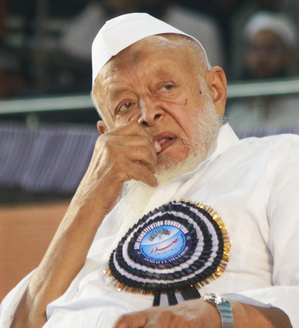
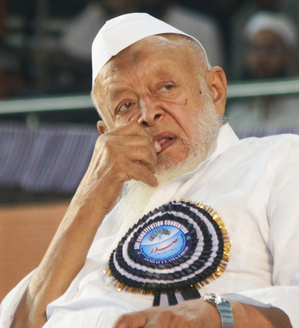
New Delhi, Jan 14 (IANS) Jamiat Ulama-i-Hind President Arshad Madani has launched a sharp attack on the Congress party, questioning its historical approach to communalism and asserting that a failure to act decisively against communal forces has pushed the country to what he described as the “brink of destruction”.

In a post on X, Madani said that decisive action at a critical moment in history could have altered the country’s trajectory.

“After the assassination of Mahatma Gandhi, had the head of communalism been crushed firmly at that very moment, the country could have been saved from destruction,” he wrote.

Criticising the party’s policies during its years in power, Madani said the Congress party adopted a lenient approach towards politics driven by religious hatred.

“The flexible policy adopted by the Congress during its rule toward politics of hatred based on religion caused severe damage to both the country and the Constitution. Seventy-seven years after independence, the manner in which the Constitution and democratic values are being openly trampled upon is something that even our leaders of the freedom movement could not have imagined,” he said.

He further added that the present situation could have been avoided had constitutional principles been implemented sincerely.

“If the Constitution had been implemented honestly and fully along the very lines on which the foundations of free India were laid, we would not be witnessing these days today,” Madani said.

Calling it an “unfortunate truth”, the Jamiat chief said that from the very beginning, Congress leaders “perhaps out of some fear, adopted a soft and flexible stance against religiously driven politics of hatred”.

He alleged that communal forces were allowed to grow due to the absence of strict legal action.

“Communal forces were treated with leniency, and strict legal action against them, as required by the Constitution and law, was avoided. As a result, communal forces were given ample opportunity to grow and strengthen,” he said.

Madani also claimed that communal forces were responsible for the assassination of Mahatma Gandhi.

“Had communalism been crushed at that very time, the country could have been saved from devastation,” he said.

Recalling events following Partition, Madani said, “After Partition, when anti-Muslim riots erupted across the country, Mahatma Gandhi went on a fast to stop them. This did not sit well with communal forces, and even with some senior leaders within the Congress. They turned against him, and ultimately he was assassinated.”

He added that Gandhi’s killing amounted to an attack on the country’s core values.

“In our view, the killing of a great personality like Mahatma Gandhi was the killing of the country’s secularism itself. Sadly, what the Congress leadership should have done at that time, it failed to do,” he said.

Madani stated that the leadership of Jamiat Ulama-i-Hind had repeatedly urged the Congress to act firmly against what he termed the “madness of communalism”.

However, he claimed these warnings were ignored. “Regrettably, this demand was not taken seriously, which further emboldened communal elements,” he said.

He also said that many people today were unaware of key historical assurances given before independence.

“Today’s generation is unaware of this history that even before independence, the senior leaders of Jamiat Ulama-i-Hind had obtained a written assurance from Congress leaders that after independence the country’s Constitution would be secular and would guarantee complete religious freedom to all religious minorities,” Madani said.

According to him, the situation changed after Independence and Partition.

“After independence and the Partition of the country, a significant section of Congress leaders joined those who argued that since a separate country had been created for Muslims in the name of religion, India’s Constitution should no longer be secular,” he said.

Madani said Jamiat leaders strongly opposed this thinking and reminded the Congress of its commitments.

“At that moment, the leadership of Jamiat Ulama-i-Hind firmly held the Congress leaders accountable and told them that if the country had been divided, it was they, not us, who had signed that document, and therefore they must fulfil their promise,” he said.

He noted that while a secular Constitution was eventually framed, communalism continued to spread unchecked.

“Consequently, a secular Constitution was framed, but the roots of communalism continued to grow silently and deeply. Despite persistent insistence by Jamiat Ulama-i-Hind, no effective restraint was placed on it, even though the Congress was in power at the Centre and in all the provinces at that time,” Madani said.

He argued that the Congress party had ample opportunity to act. “Had it wished, it could have enacted strict laws against communalism. But due to the flexible policy it adopted, communal forces kept becoming stronger,” he added.

The Jamiat Ulama-i-Hind said that the Congress was paying the price for its past approach.

“If the Congress had taken the same strict stand against communalism 77 years ago that it claims to be taking now, it would not have been ousted from power, and the country would not have reached the brink of destruction,” Madani said.

–IANS

sd/dpb

Germany sees India as key partner in trade, defence

New Delhi, Jan 14 (IANS) Germany’s Chancellor Friedrich Merz has used his first official visit to India to signal that Berlin now sees New Delhi as a central partner for trade, technology and security in an increasingly fractured world order. Spread over two days in Ahmedabad and Bengaluru, the visit combined high symbolism with a dense agenda on defence, green transition, mobility and a long‑pending India–EU trade deal, according to an article in India Narrative.

Prime Minister Narendra Modi received Merz in Ahmedabad, where the programme blended political signalling with cultural outreach. Bilateral talks and press statements at Gandhinagar’s Mahatma Mandir provided the formal backdrop for announcements on trade, defence and technology.

The article highlights that economics was the central pillar of the visit, with Merz accompanied by a high‑powered delegation of 23 German CEOs and industry leaders. Both leaders noted that Germany already accounts for over a quarter of India’s trade with the EU and that bilateral trade has hit record highs since 2024, strengthening the case for a more ambitious agenda.

Merz sent a clear signal of the political backing the long‑pending India–EU Free Trade Agreement, as he observed that the deal could be concluded by the end of January. New Delhi and Berlin also welcomed a new Joint Declaration of Intent to strengthen economic cooperation through a German‑Indian CEO Forum, pitched as a permanent channel to deepen investment, technology partnerships and resilient supply chains.

Security and defence industry cooperation received unusually prominent attention for a German leader’s India visit. Modi and Merz backed expanded military‑to‑military engagement through joint exercises and senior‑level exchanges, and endorsed a new roadmap for defence‑industrial cooperation focused on long‑term technology partnerships and co‑development of equipment in India, the article states.

The two countries held discussions on a multi‑billion‑euro project to jointly build submarines in India, aligning Germany’s defence export push with India’s Make in India and Atmanirbhar Bharat priorities. Beyond defence, the two sides signed or exchanged 19 MoUs and eight major announcements across clean energy, digital technology and innovation, framed as tools to advance green and sustainable development.

People‑centric measures were another notable highlight, with India publicly welcoming Germany’s decision to allow visa‑free transit for Indian passport holders, expected to ease travel and business connectivity via German hubs. New agreements on higher education, skilling, renewable‑energy training, sports cooperation, maritime heritage and youth exchanges were showcased as investments in the next generation of the partnership, the article added.

–IANS

sps/na

India’s WPI inflation edges up to 0.83 pc for Dec

New Delhi, Jan 14 (IANS) India’s inflation rate based on wholesale prices was estimated at 0.83 per cent for December 2025 compared to the same month of the previous year with the positive rate primarily due to the increase in prices of manufactured goods and minerals, according to figures released by the Commerce and Industry Ministry on Wednesday.

Food inflation was estimated at 0 per cent as there was no increase in the wholesale prices of food in December, compared to the same month of the preceding year.

The manufactured products group which has a weight of 64.23 per cent in WPI increased by 0.41 per cent during the month. Out of the 22 products in the group, 13 groups witnessed an increase in prices, 8 groups witnessed a decrease in prices and one group witnessed no change in prices.

Some of the important groups that showed month-over-month increase in prices were basic metals; chemicals and chemical products; textiles and other non-metallic mineral products. Some of the groups that witnessed a decrease in prices were manufacture of rubber and plastics products; food products; computer, electronic and optical products; paper and paper products and beverages etc. in December 2025 as compared to November 2025.

India’s inflation rate based on wholesale prices was in the negative zone in November, as prices declined by (-) 0.32 per cent during the month compared to the same month of the previous year. WPI-based inflation was (-) 1.21 per cent in the previous month of October and 2.16 per cent in November last year.

Meanwhile, the country’s inflation rate based on the Consumer Price Index (CPI) was estimated at 1.33 per cent for December 2025 which is marginally higher than the corresponding figure of 0.71 per cent for November.

Food inflation stayed in the negative zone during December at -2.71 per cent as prices of food goods fell compared to the same month of the previous year. Food inflation has now stayed negative for the seventh month in a row, easing the burden on household budgets. However, the figure for Dec was a tad higher than the -3.91 per cent recorded for Nov.

However, the overall outlook for inflation remains benign. The RBI’s monetary policy committee (MPC) last month slashed its forecast for India’s inflation rate for the financial year 2025-26 to 2 per cent from 2.6 per predicted in October due to the sharp decline in food prices and the GST rate cuts playing out.

RBI Governor Sanjay Malhotra announced a reduction in the repo rate by 25 basis points to 5.25 per cent from 5.5 per cent earlier as inflation has come down and the monetary policy could focus on boosting growth.

Malhotra said that the surge in economic growth to 8.2 per cent growth in the second quarter of the current financial year and the sharp decline in inflation to 1.7 per cent provided a rare “Goldilocks period” for the Indian economy.

–IANS

sps/na

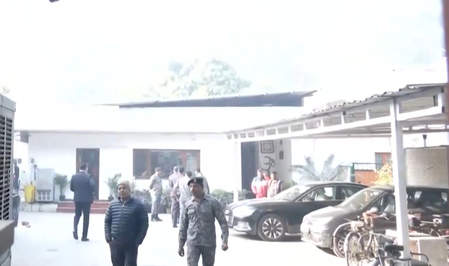
We are all safe: BJP MP Ravi Shankar Prasad says fire at Delhi residence due to short circuit

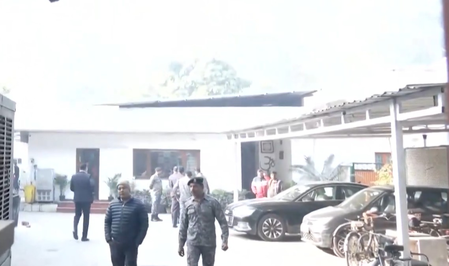
New Delhi, Jan 14 (IANS) BJP MP Ravi Shankar Prasad on Wednesday said that he and his family were not present at their New Delhi residence when the fire broke out earlier in the day.

He said that the cause of the fire was a short circuit, which damaged a few household items. He informed that he was in Patna along with his family and thanked everyone for their concern.

In a post on X, Prasad said, “Today, a fire broke out in an outer room of my Delhi residence, possibly due to a short circuit, which has caused damage to some household items. I myself, my wife, and my son are in Patna.”

“This morning, the fire brigade quickly intervened and extinguished the fire, and the rest of the investigation is ongoing. We are all safe. Thank you everyone for your good wishes,” the BJP MP added.

A fire broke out in Prasad’s residence in New Delhi at around 8:00 a.m. in one of the bedrooms of the residence, authorities said.

Upon receiving the information, three teams of the Delhi Fire Services (DFS) reached the spot, and the blaze was brought under control, officials said.

Ravi Shankar Prasad, representing Patna Sahib constituency in the Lok Sabha, has served as the Minister of Electronics and Information Technology from 2016 to 2019 and from 2019 to 2021.

The BJP leader has served as a Member of Parliament since 2000 — first in the Rajya Sabha (2000–2019) and then in the Lok Sabha (since 2019). He has also served as a Union Minister multiple times.

This latest blaze added to the series of fire-related incidents in the national Capital of late.

Earlier, on January 6, three people were killed in a massive fire that broke out on the second floor of the Delhi Metro staff quarters in Adarsh Nagar.

The deceased were identified as Ajay (42), Neelam (38), and their 10-year-old daughter, Janhvi.

Earlier this month, too, a fire broke out in the top-floor flat of a five-story building in Mandawali. The fire was caused by a gas cylinder explosion, according to the DFS.

Three firefighters were injured in the operation and were shifted to a nearby hospital for treatment.

–IANS

sd/rad

K’taka woman suicide case: Family alleges role of JD(S) leader’s son, police inaction

Karwar (Karnataka), Jan 14 (IANS) The suicide case of a young woman in Karwar district has taken a twist, with the victim’s family on Wednesday alleging the involvement of a JD(S) woman leader’s son and police inaction.

The family of the deceased has written letters to Chief Minister Siddaramaiah and Home Minister G. Parameshwara, but claim that no action has been initiated against the accused so far.

Rishale D’Souza died by suicide on January 9 in Kadra village of Karwar taluk. Christoda Francis D’Souza, the victim’s mother and the complainant in the case, has alleged that the son of a JD(S) leader had sexually assaulted and tortured her daughter. A complaint in this regard was lodged at the Kadra police station on January 10.

Speaking to the media on Wednesday, Christoda D’Souza said, “We have received information that the accused brutally tortured Rishala. Bite marks were found on her body during the post-mortem.” She demanded that the investigation be conducted properly.

“My daughter should get justice. We strongly suspect that the accused took her somewhere and tortured her brutally for two days before she died by suicide,” she said.

While publicly naming the accused, D’Souza said he was directly responsible for her daughter’s death. “They were friends,” she said, adding that when Rishala attempted suicide, they took her to the hospital, where the accused’s supporters were already present.

“They threatened my son not to file a case. We strongly suspect the accused’s role, and he is absconding. This is the fifth day since Rishala’s death, and no action has been taken so far,” she added.

The FIR states, “The accused was known to the complainant’s daughter, Rishale. He used to call her over the phone and talk to her, and would frequently loiter around the complainant’s house. By expressing his love, he would harass the complainant’s daughter. When the complainant’s daughter rejected the accused’s advances, the accused allegedly told her, ‘There is no use in your living. You should somehow die. It would be better if you died rather than lived’, as the complainant’s daughter later informed the complainant.”

It further states, “Due to the accused’s same malicious instigation, the complainant’s daughter, Rishale, allegedly died by suicide on January 9 between 2.30 p.m. and 2.45 p.m. by hanging herself with a saree from the ceiling fan in the bedroom of the house where she was residing, as stated in the complaint.”

The police have registered a case under BNS Section 108 (abetment of suicide) against the accused person.

–IANS

mka/dpb