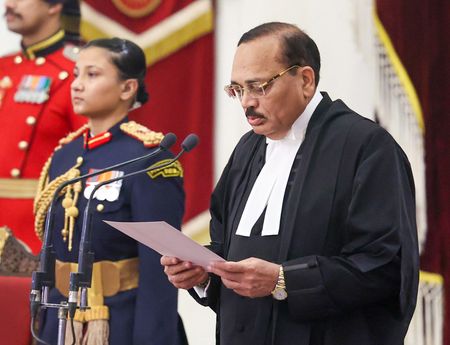
Jaipur, Feb 21 (IANS) The Chief Justice of India (CJI), Surya Kant, on Saturday delivered a thought-provoking address at the 18th Convocation Ceremony of the National Law University (NLU), Jodhpur, urging young graduates to view law as a dynamic and evolving institution rather than a rigid structure.
Speaking on the theme ‘From Fortress to Forum – Law in an Unfinished Republic,’ the CJI said that law must evolve with society and function as a platform for dialogue, rights, and accountability.
Drawing an analogy with the iconic Mehrangarh Fort, the CJI said early legal systems were designed like fortresses — structures built to defend society from chaos and arbitrariness.
However, in a modern constitutional democracy, law must transform into a forum where differences are debated, rights are articulated, and power is held accountable through reason, not resistance.
He cautioned graduates against believing that law is a finished product, stating that unlike scientific equations, law evolves with human experience.
Quoting Justice Oliver Wendell Holmes Jr., he said, “The life of the law has not been logic; it has been experience.”
The CJI highlighted that the Indian Constitution is a living document, interpreted by every generation in light of contemporary realities.
He traced the evolution of legal principles from Magna Carta (1215) to modern constitutional guarantees of equality, dignity, and liberty. He noted that Article 14 of the Constitution, which guarantees equality before the law, has evolved from a formal principle into a tool for achieving substantive justice.
CJI Kant warned that law risks becoming a “fortress” again if it becomes overly complex, jargon-filled, and accessible only to the elite.
“Your task is not to make law more arcane, but more intelligible; not to narrow the forum, but to widen it,” he told the graduating students.
He emphasised that law is a public trust, and lawyers must prioritise integrity, clarity, and conscience over spectacle and convenience.
He praised NLU Jodhpur for emerging as one of India’s leading law schools and noted that its alumni serve across the judiciary, academia, corporate law, and public service.
He said such institutions carry a responsibility to ensure that legal excellence does not become exclusion. In a lighter moment, he referred to campus life at NLU Jodhpur, recalling student rivalries, mess hall debates, and social spaces as “forums” where ideas and friendships were shaped.
Concluding his address, he urged graduates to act as architects of an open legal forum, not guardians of a closed fortress.
“May your advocacy open doors rather than erect walls. May your work make the law more accessible, not more distant,” he said.
He also congratulated parents, faculty, and the graduating class, wishing them success in their professional journeys.
–IANS
arc/rad