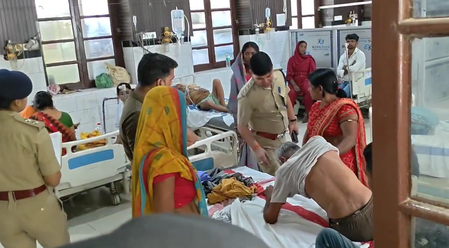
Patna, April 4 (IANS) The situation in parts of East Champaran in Bihar has turned grim, as the hooch tragedy continues to deepen its toll.
In the Turkaulia and Raghunathpur areas of the district, fear and mourning now define everyday life, with the death toll rising to six after one more victim succumbed during treatment on Saturday.
Over 15 individuals remain hospitalised, fighting for survival. Some of them permanently lost their eyesight.
So far, Pramod Yadav, Chandu Kumar, Parikshan Manjhi, Sampat Shah, Heeralal Mahto, and Lal Kishore Yadav lost their lives in the hooch tragedy.
They had consumed spurious liquor on April 1, and their health deteriorated on April 2.
Chandhu Kumar and Pramod Yadav lost their lives on April 2, Parikshan Manjhi, Sampat Shah and Heeralal Mahto died on April 3, and Lal Kishore Yadav succumbed on April 4.
While police and medical teams are actively working on the ground, this tragedy has once again raised serious concerns about enforcement and administrative accountability.
As the investigation progresses, disturbing details have emerged.
In a significant disciplinary action, the Station House Officer (SHO) of Turkaulia police station has been suspended, and a village watchman has been arrested.
Shockingly, the watchman was allegedly in direct contact with liquor smugglers—highlighting how those entrusted with maintaining vigilance became complicit in the crime.
During raids, authorities seized nearly 700 litres of highly toxic spirit—the same substance believed to have caused the deaths.
Officials say that timely intervention may have prevented this disaster.
So far, more than a dozen individuals, including Naga Rai, the supplier of the spurious liquor, have been arrested.
The police have launched an extensive crackdown—often referred to as “Operation Clean”—involving continuous raids, surveillance, and intelligence gathering to dismantle the illicit network from its roots.
However, beyond the arrests and seizures, the tragedy leaves behind deeper questions: How did such a large-scale illegal operation thrive despite prohibition? And how many more such hidden networks might still exist?
For now, Motihari mourns—caught between grief, anger, and the hope that accountability will follow this devastating loss.
A heavy silence hangs over the affected villages—homes filled with grief, streets subdued, and an overwhelming sense of loss in the air.
–IANS
ajk/uk