New Delhi, Feb 15 (IANS) The India-UK free trade agreement is likely to come into effect from April this year, paving the way for an increase in Indian exports to the European nation, according to a senior official on Sunday.
The agreement was signed between the two countries in July last year and has to be now approved by the UK Parliament for it to come into effect.
The process has already started with the debate on the Free Trade Agreement (FTA) having begun in the both Houses of the British Parliament.
“Under the free trade agreement, 99 per cent of Indian exports to the UK will get the benefit of zero duty. This opens up massive export opportunities for labour-intensive sectors such as textiles, marine products, leather, footwear, sports goods and toys, gems and jewellery, and other important sectors such as engineering goods, auto parts and engines, and organic chemicals,” according to an official statement.
Besides, India has ensured that non-tariff barriers are suitably addressed to ensure free flow of goods and services and that they do not create unjustified restrictions to India’s exports.
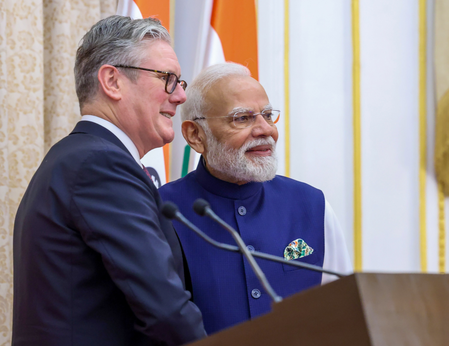
Prime Minister Narendra Modi and his British counterpart Keir Starmer announced the successful conclusion of the mutually beneficial India-UK FTA in May last year.
The deal was sealed after PM Modi spoke to the UK Prime Minister on the phone.
Apart from the FTA, a Double Contribution Convention has also been signed to take care of the interests of Indian workers in the UK.
There will also be a significant boost to trade in services, such as Information Technology/Information Technology Enabled Services, financial services, professional services, other business services and educational services.
India has also secured an exemption for Indian workers, who are temporarily in the UK and their employers from paying social security contributions in the UK for a period of three years under the Double Contribution Convention.
This will make Indian service providers significantly more competitive in the UK.
Under the agreement, tariffs on Scotch whisky will be reduced from 150 per cent to 75 per cent and further brought down to 40 per cent by 2035.
India will also gradually cut import duties on automobiles, from up to 110 per cent to 10 per cent over five years under a quota-based system. In return, Indian manufacturers will receive market access in the UK for electric and hybrid vehicles within a quota framework.
The FTA takes place in the backdrop of growing economic relations between India and the UK as exemplified in the bilateral trade of about $60 billion, which is projected to double by 2030.
–IANS
sps/khz