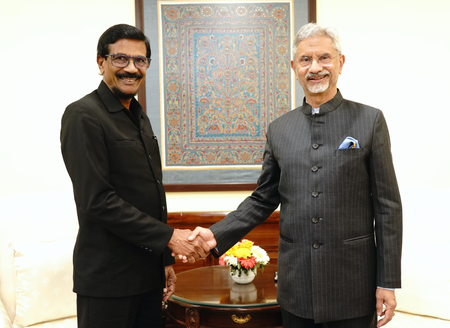
Colombo, Feb 21 (IANS) The recent visit of Tilvin Silva, General Secretary of the Anura Kumara Dissanayake-led Janatha Vimukthi Peramuna (JVP) party, to India highlighted a subtle blend of opportunity and challenge. Silva noted that India emphasised development and innovation rather than exerting political pressure on Sri Lanka to hold the long-delayed Provincial Council elections, a report said on Saturday.
According to a report in Sri Lanka-based think tank ‘Trinco Centre for Strategic Studies’ (TCSS), at the heart of Sri Lanka’s evolving political landscape lies a crucial question: whether Silva gained insights from his first official visit to India.
“Undertaken through the Indian Council for Cultural Relations’ (ICCR) Distinguished Visitors Programme from 5–12 February 2026, the visit carried both symbolic and practical significance. During his time in India, Silva held discussions with External Affairs Minister S. Jaishankar and toured Gujarat and Andhra Pradesh — states often highlighted as showcases of India’s economic and technological progress,” the report detailed.
His comparisons between India and China, it said, prompted broader questions about which model Sri Lanka should adopt to chart its own future.
“In India, we see that though there are efforts to introduce new technology, there have been some obstacles in implementing these initiatives because there are religious and cultural practices and traditions that have to be navigated. In China, it is not like that,” the report quoted Silva as saying.
It noted that Silva’s position on Provincial Council elections in Sri Lanka remained ambiguous. When the Tamil issue came up during his stay in India, he stressed that he was there in his capacity as the JVP’s General Secretary, speaking on behalf of the party, not the government.
“At the same time, he has consistently characterised the provincial council system as a failed model. This raises an important consideration: should his remarks be understood as reflecting the party’s position, or as signalling the policy direction of the government?” the report questioned.
The TCSS report highlighted that it is not a matter of whether India is exerting pressure, but whether Sri Lanka would proceed with Provincial Council elections without any external influence.
“Silva believes that if the JVP is to act as a ‘responsible government,’ it must conduct elections and ensure balanced economic development across all provinces,” it stated.
The report further said, “India’s stance is not a ‘proxy’ for Tamil demands, but rather the responsibility of a neighbour with more than 85 million Tamil-speaking people in South India. Ensuring Tamil rights in Sri Lanka, India argues, benefits Sri Lanka itself, not India”.
It noted that India is founded on inclusive development rather than ethnic or religious identity. For a multilingual democracy like Sri Lanka, power sharing offers the best path forward, while a totalitarian model like China underscores a very different reality.
–IANS
scor/as