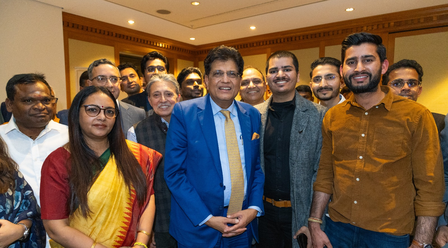
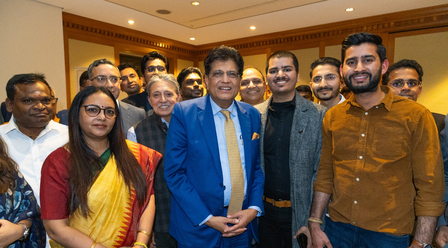
Berlin, Oct 25 (IANS) Commerce and Industry Minister Piyush Goyal said he is “delighted” after interacting with the members of the Indian diaspora in the Berlin, adding that India is immensely proud of their achievements across diverse sectors for being critical partners in India’s growth as well as acting as catalysts for further deepening the ties with Germany.
Taking to his official X account, Minister Goyal on Friday wrote: “Delighted to interact with the vibrant Indian community in Berlin. We are proud of their achievements across sectors. Called upon them to continue being partners in India’s growth and catalysts for deeper India–Germany ties.”
The Minister is currently on an official visit to Berlin, which started on October 23, aimed at deepening India’s economic engagement with Germany
The Berlin visit marks a key milestone in enhancing India’s engagement with Germany and holds particular significance, as the year 2025 marks the 25th anniversary of the India-Germany Strategic Partnership, highlighting the depth, resilience, and long-standing strength of bilateral ties. Goyal’s meetings are designed to facilitate high-impact interactions with senior government officials, industry leaders, and business associations in both countries, according to an official statement.
As part of his visit, Goyal also participated as a speaker at the third Berlin Global Dialogue (BGD) — an annual summit that brought together leaders from business, government, and academia to deliberate on issues shaping the global economy.
He met Anne-Laure Parrical de Chammard, Siemens Energy Executive Board member, on Friday, and held discussions on deepening collaboration for building more reliable, affordable, and sustainable energy systems.
In a post on X, Goyal wrote: “Pleased to meet Anne-Laure Parrical de Chammard, Member of the Executive Board, @Siemens_Energy. Our discussions focused on deepening collaboration for building more reliable, affordable, and sustainable energy systems. The company’s expertise in reducing emissions across the energy landscape aligns well with India’s clean energy transition and growth ambitions.”
Minister Goyal also met with the leadership of the Federation of German Industries in Berlin and discussed efforts to deepen industrial collaboration and strengthen India-Germany trade relations with various business leaders.
“Wonderful meeting with the leadership of the Federation of German Industries, @Der_BDI. Discussed strategic initiatives to further strengthen Indo-German trade relations, deepen industrial collaboration, and enhance the role of our businesses in shaping the future of global trade,” the Union Minister posted on X.
Minister Goyal also met Morten Wierod, CEO of ABB Group, and shared India’s rapid strides in manufacturing.
In a post on X, the Union Minister said, “Met Morten Wierod, CEO, ABB Group. Shared how India’s rapid strides in manufacturing, infrastructure, and clean energy present vast opportunities for the group to deepen its partnership with our growth story, by leveraging its engineering and digitalisation expertise.”
Goyal, on Friday met Airbus Chairman Rene Obermann, who expressed strong confidence in India’s growth story and technological capabilities.
In a post on X, he said, “Wonderful meeting with Rene Obermann, Chairman of the Board of Directors, Airbus. Delighted to hear his confidence in India’s growth story. We discussed how Airbus plans to further strengthen its partnership with India by leveraging the country’s remarkable engineering and technological talent, forward-looking policy initiatives, and improved Ease of Doing Business.”
Earlier, Minister Goyal also met Valdis Dombrovskis, the EU Commissioner for Economy and Productivity, in Berlin.
“Delighted to meet my friend Valdis Dombrovskis, EU Commissioner for Economy and Productivity, and for Implementation and Simplification, over lunch in Berlin. We discussed the significant progress in the India-EU Free Trade Agreement negotiations and our commitment to resolving outstanding issues for a balanced and mutually beneficial trade deal,” he wrote on X.
“Met with German CEOs at the Business Leaders’ Roundtable in Berlin. Highlighted India’s robust reforms agenda, vast opportunities, and future potential across sectors. Reiterated how our supportive policy ecosystem, fostering innovation and entrepreneurship, continues to make the country one of the most attractive investment destinations globally,” Minister Goyal wrote in another X post.
“Delighted to participate in the panel discussion on ‘Growing Together: Trade and Alliances in a Changing World’ at the Berlin Global Dialogue. Emphasised on how India continues to look at its trade partnerships from the prism of long-term mutual growth. Highlighted the vast opportunities that are opening up in the country for global companies to participate in and build for the future,” he wrote on X.
Minister Goyal on Thursday met Katherina Reiche, German Federal Minister for Economic Affairs and Energy, in Berlin, and talks covered Germany’s commitment to finalising the India-EU free trade agreement (FTA).
Goyal is in Germany to engage with CEOs and industry leaders to boost bilateral trade and investment.
“It was a pleasure to meet Katherina Reiche, German Federal Minister for Economic Affairs and Energy, in Berlin. Our discussions focused on deepening Indo-German ties in trade and investment, joint industrial and technological partnerships in green energy, new and emerging technologies, as well as defence. Talks also covered Germany’s commitment to finalising the India-EU FTA,” said Goyal in a post on X.
“I highlighted how India’s large talent pool, combined with our push for Ease of Doing Business, offers attractive prospects for German companies to diversify investments and strengthen supply chain resilience,” the Minister noted.
–IANS
int/khz