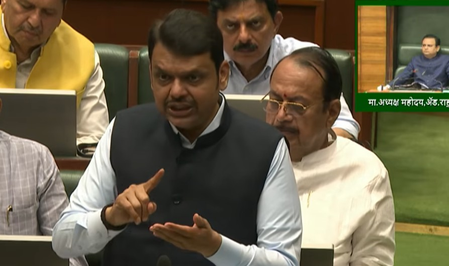
Mumbai, Feb 24 (IANS) Amid strain on state finances, Maharashtra Chief Minister Devendra Fadnavis, who holds the charge of planning and finance departments, on Tuesday tabled the supplementary demands worth Rs 11,995 crore for the remaining period of the fiscal 2025-26.
Of the Rs 11,995 crore, the state government has earmarked Rs 3,112.85 crore to meet the expenses incurred on the concession given in the electricity tariff to Agriculture pump, power loom and textile consumers in the state, and Rs 803.94 crore has been proposed as incentives to small, medium, large industries and mega projects under the package scheme of incentives.
The government has proposed Rs 4,792.02 crore for transferring the loan amount to the state power distribution company, Mahavitaran, which has been received from the Asian Infrastructure Investment Bank for the solar agriculture pump scheme. This allocation is aimed at pushing the government’s plan to use 52 per cent renewable energy by 2030 under the net zero mission.
The government has also proposed Rs 1,431.05 crore as an additional fund as part of the Central share for the implementation of the Jal Jeevan mission. In March 2025, Ajit Pawar had presented the budget with a revenue deficit of Rs 45,890 crore.
In June 2025, the government presented the supplementary demands worth Rs 57,509.71 crore, crossing the revenue deficit of Rs one lakh crore.
In the Winter Session during December 2025, with supplementary demands of Rs 75,286.37 crore, the revenue deficit had already touched the Rs two lakh crore mark. In addition to the revenue deficit of Rs 45,891 crore, the budget 2025-26 had projected that Maharashtra’s debt burden is set to rise to Rs 9.32 lakh crore. In Tuesday’s supplementary demands, the state government has not only refrained from proposing any new and additional expenses but has focused solely on Power subsidies for farmers and Industry incentives.
CM Fadnavis will present the state budget for the year 2026-27 on March 6. He has already announced in the press conference on Sunday that there could be strict measures to maintain financial discipline.
Earlier, speaking at the World Economic Forum (WEF) annual meeting, the Chief Minister had said that the state is on track to generate 16 gigawatts (GW) of solar power by the end of this year. By 2032, the state aims to generate an additional 45 GW, with 70 per cent coming from solar. Renewable energy, which stood at 13 per cent four years ago, is projected to reach 52 per cent by 2030,” he said.
Following Prime Minister Narendra Modi’s vision, the state launched Asia’s largest decentralised solar scheme.
By shifting the entire agricultural load to solar power and establishing a dedicated company for farmer supply, the state is making every agricultural feeder independent.
“The cost of supplying power to farmers has dropped from Rs 8 to less than Rs 3 per unit. This transition is not only helping farmers but also reducing the financial burden on industries and households,” the Chief Minister noted.
The government is advancing a capital outlay for pumped storage hydro projects (combined capacity of 5,630 MW) with an estimated total investment of Rs 24,631 crore.
–IANS
sj/dpb