Chennai, Jan 15 (IANS) Once envisioned as a key urban water buffer along Chennai’s Radial Road, Putheri Lake continues to remain in distress despite a high-value restoration plan announced nearly a year ago.
The prolonged delay has left the lake struggling with chronic sewage inflow, shrinking boundaries due to encroachments, and growing piles of solid waste, raising concerns over the effectiveness and sequencing of restoration efforts.
Putheri Lake forms part of a chain of waterbodies along the 14.3-km Radial Road, coming immediately after Pallavaram Periya Eri.
Spanning 10.45 acres, the lake was taken up for restoration last year after the Chennai Metropolitan Development Authority floated a Rs 3.4 crore tender aimed at improving its storage capacity and ecological condition. However, progress on the ground has been uneven, with work confined largely to one section of the lake.
On the southern side, limited desilting and removal of water hyacinth have been carried out. Despite this, the main inlet to the lake has been blocked by a concrete step, while multiple sewage entry points remain open.
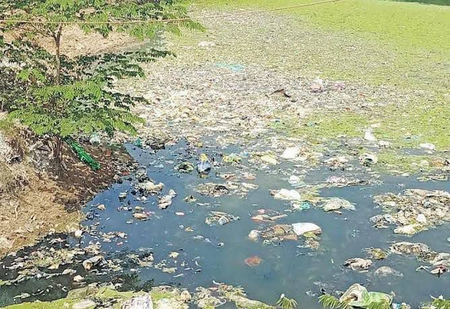
The excess water outlet channel, meant to carry overflow towards Keelkattalai Lake, has not been properly desilted. As a result, the causeway in this stretch is choked with plastic waste, household rubbish, and stagnant sewage, severely affecting water flow.
Conditions on the northern side are far worse. This portion of the lake continues to receive untreated sewage and is heavily overrun by water hyacinth. No restoration work has commenced here, and the area has effectively turned into an open dumping ground.
A busy road along the northern bund, leading to a private educational institution, is used daily by thousands of students and residents. Persistent dumping of meat waste and domestic garbage along this stretch has raised serious public health and sanitation concerns.
Encroachments around the lake remain unresolved. Though several structures have been identified on land that originally formed part of the lake, restoration work has proceeded without first reclaiming these areas, further limiting the project’s effectiveness.
Environmental specialists caution that without first arresting sewage inflow and reclaiming encroached land, restoration measures will deliver only cosmetic improvement.
Officials, however, say the approved plan covers both the northern and southern sides of the lake and that sewage inlets will be sealed once work on the southern portion is completed, after which restoration on the northern side will begin. Residents say timely, coordinated action is critical to prevent further decline of this urban waterbody and to restore its role in drainage, groundwater recharge, and public health protection.
–IANS
aal/dpb