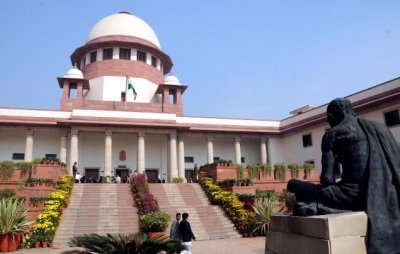
New Delhi, Feb 23 (IANS) The Supreme Court on Monday expressed serious concern over the “endless litigation” continuing under the long‑running environmental cases titled MC Mehta vs Union of India, which involve monitoring issues of air pollution in Delhi and the environment of the Taj Trapezium Zone.
A bench headed by Chief Justice of India (CJI) Surya Kant remarked that the continued filing of interlocutory applications (IAs) and miscellaneous applications (MAs) was creating an incorrect impression that cases decided long ago were still pending.
Taking note of the large number of pending applications, the Bench, also comprising Justices Joymalya Bagchi and Vipul M. Pancholi, observed: “What is happening in this court? IA after IA is being filed in this court. MC Mehta alone has 85 pending ones. Then you will ask the Parliament how many cases are pending before us. We will not go through such embarrassment.”
It added that several matters originally instituted in 1984 and 1985 had been decided decades ago, yet continued filings have kept them reflected as pending proceedings.
“It appears that there are multiple matters which are shown pending as MC Mehta v. UoI. There is one of 1984 — decided decades ago — yet miscellaneous applications are being filed and listed as if the 1984 petition is still pending. Another matter of 1985 too was decided, but due to IAs and MAs, it is shown as alive,” the apex court noted in its order.
The CJI Surya Kant-led Bench directed that three major MC Mehta matters, including the Taj Trapezium case, be listed on separate dates, with all pending IAs to be tagged and heard independently on the respective dates fixed.
It further asked court officials and counsel appearing in the matters to assist in re-captioning the cases so that disposed-of petitions are not treated as continuing litigation.
“We want identification of matters so that old cases are not kept alive merely because applications are filed. The exercise should also identify cases that can appropriately be transferred to jurisdictional High Courts,” the Supreme Court said, directing that no further IAs would be entertained in the 1985 matter.
In a related development, the CJI Surya Kant-led Bench took note of submissions made by Additional Solicitor General Aishwarya Bhati on behalf of the Commission for Air Quality Management (CAQM) regarding long‑term measures to tackle the air quality crisis in Delhi-NCR.
The apex court recorded that the CAQM has identified specific agencies responsible for implementing its recommendations.
Directing strict compliance, the Supreme Court ordered the Delhi government and its agencies to submit a detailed action-taken plan outlining steps to implement the long-term solutions proposed by the CAQM.
“It may be seen that while making multifarious recommendations, CAQM has also identified the concerned agencies who are expected to take necessary action to give effect to these recommendations,” the bench said in its order.
It also asked the Union Ministry of Environment, Forest and Climate Change, the Ministry of Power, and the Ministry of Petroleum and Natural Gas to place before it a joint proposal for shifting all coal-based industries out of the Delhi-NCR region.
The proposal must identify such industries and specify viable alternative fuel sources, the apex court said.
It also sought responses on a CAQM recommendation to prohibit the establishment of any new coal-based thermal power plant within a 300-kilometre radius of Delhi. Further, the governments of Uttar Pradesh, Haryana and Rajasthan were directed to issue public notices inviting suggestions and objections from stakeholders, including coal-based industries.
The Supreme Court reiterated the need to implement CAQM’s long-term recommendations in a phased manner across sectors, including abatement of dust pollution from construction and demolition activities, road dust management, prevention of paddy stubble burning, greening and plantation in NCR, and strengthening of air quality governance mechanisms.
–IANS
pds/vd