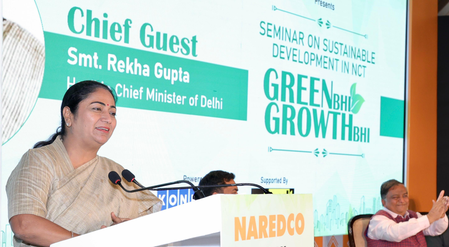
New Delhi, Jan 16 (IANS) Delhi Chief Minister Rekha Gupta said on Friday that the government is working 12 months a year, seven days a week, to control pollution in Delhi-NCR, and that a comprehensive, time-bound plan is underway to counter the challenge.
Short-term and long-term plans have been prepared and are under effective implementation, she said after chairing a high-level review meeting on air pollution control at the Delhi Secretariat.
She added that the fight against pollution is a long one and all agencies are working with a comprehensive strategy.
Chief Minister Gupta said that guidance and support from the Central Government are also being received in this fight, and hence a comprehensive and time-bound plan is underway to decisively tackle the challenge of air pollution.
These efforts will lead to an improvement in pollution levels and safeguard public health, she said.
The review meeting was attended by Cabinet Ministers Parvesh Verma, Manjinder Singh Sirsa and Pankaj Kumar Singh, Chief Secretary Rajiv Verma, and senior officials from the DDA, Delhi Traffic Police, Municipal Corporation of Delhi, PWD, Environment Department, Industries, Transport and several other departments.
The Chief Minister directed all departmental heads to work effectively in accordance with the approved blueprint for pollution control and to ensure time-bound implementation.
She stated that the Delhi government is continuously receiving guidance from Prime Minister Narendra Modi and the Central Government to effectively control air pollution in Delhi-NCR.
Both governments are committed to this goal and there are neither procedural hurdles nor budgetary constraints, she said.
The Chief Minister said that her government is working on a clear, measurable and outcome-oriented action plan to achieve a substantial reduction in PM2.5 levels over four years.
On the transport sector, she said Delhi plans to increase its total bus fleet to 6,000 by December 31, 2026; 7,500 by December 2027; 10,400 by March 2028; and 14,000 by March 2029.
Of the planned 14,000 buses, 500 will be 7-metre-long buses to strengthen last-mile connectivity, she said.
These buses will be seamlessly integrated with the Delhi Metro network to ensure deep penetration of public transport in residential, commercial and high-density areas. At present, last-mile connectivity is being provided through the deployment of 100 electric metro feeder buses.
By January 31, 2026, pilot integration of e-autos, bike taxis and feeder cabs at 10 major metro stations is planned, she said.
She said that under the new Electric Vehicle Policy, Delhi’s 5.8 million two-wheelers are being primarily targeted through subsidies and scrappage incentives.
The number of public charging and battery-swapping points will be increased from the existing 9,000 to 36,000. Interest subvention for commercial trucks and three-wheelers, along with benefits under the Centre’s PM E-Drive scheme, are being leveraged to facilitate a transition to cleaner fuels, she said.
–IANS
rch/pgh