Washington, Feb 21 (IANS) US President Donald Trump has mounted a forceful and combative defence of his trade agenda after the Supreme Court curtailed his use of a key tariff authority, accusing unnamed “foreign interests” of influencing the justices, announcing a new 10 per cent global tariff and signalling that even steeper trade measures — including embargoes — could follow.
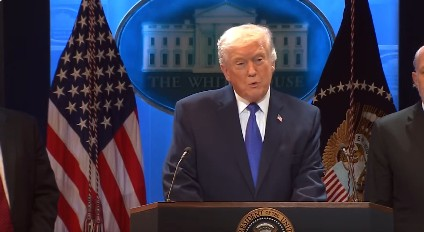
Speaking at a White House news conference on Friday afternoon that blended grievance, policy, and political activism, Trump called the apex court’s judgment “deeply disappointing” and said he was “ashamed of certain members of the court for not having the courage to do what’s right for our country”.
He singled out Justices Clarence Thomas, Samuel A. Alito Jr., and Brett M. Kavanaugh for praise, saying they showed “strength and wisdom and love of our country”, while sharply criticising the majority.
Of the two justices Trump had appointed who ruled against him, he said the court decision was “an embarrassment to their families”, though the US President declined to say whether he regretted nominating them.
The apex court’s ruling struck down the current US President’s use of a specific emergency economic authority to impose tariffs, but Trump insisted that the court decision did not undercut his broader trade programme.
“The Supreme Court did not overrule tariffs,” the US President said.
“They merely over… a particular use of International Emergency Economic Powers Act (IEEPA) tariffs.”
Within hours, President Trump announced a new decision after the Supreme Court’s judgment on striking down trade tariffs.
“Today, I will sign an executive order to impose a 10 per cent global tariff under Section 122,” he said, adding that national security tariffs under Section 232 and existing Section 301 tariffs would “remain in place, fully in place and in full force and effect”.
Pressed on whether the new legal route would limit his flexibility, Trump suggested the opposite.
“Potentially higher,” the US President said when asked whether tariff rates could increase beyond current levels.
“It depends whatever we want them to be.”
President Trump added, “We can judge much more than I was charging.”
At several points, the US President said that the Supreme Court judgment had actually strengthened his hand by clarifying alternative powers.
“There will no longer be any doubt,” Trump said, contending that other statutes were “even stronger than our original choice” and could bring in “far greater” revenue than the “hundreds of billions of dollars” he said had already been collected.
The US President went further, emphasising the breadth of executive authority he believed the court had affirmed.
“I can embargo,” he said.
“I can do anything I want.”
The US President elaborated: “In other words, I can destroy the trade… I can destroy the country. I’m even allowed to impose a foreign country-destroying embargo.”
In one of the most striking moments of the appearance, Trump accused the justices of being influenced by outside forces.
“It’s my opinion that the court has been swayed by foreign interests,” he said.
Asked whether he had evidence, the US President replied, “You’re going to find out what?”
Trump suggested that “foreign interests are represented by people that I believe have undue influence”, adding, “They have a lot of influence over the Supreme Court, whether it’s through fear or respect or friendships, I don’t know.”
Beyond the legal fight, Trump cast tariffs as central to his economic and foreign policy worldview.
He said they had revived American manufacturing, citing a visit to a steel plant in Georgia where, he recounted, an executive told him, “Sir, I want to kiss you,” because foreign imports had stopped and hiring had surged.
He also tied tariffs to diplomacy.
“Tariffs have likewise been used to end five of the eight wars that I settled,” President Trump said.
The US President added that the US economy was thriving under his approach, pointing to stock market milestones and job gains.
“Our stock market has just recently broken 50,000 on the Dow… and… broken 7,000 on the S&P,” he said, describing the country as “the hottest country anywhere in the world right now”.
Yet the Supreme Court’s judgment introduced uncertainty over billions of dollars in tariff revenue already collected.
Asked about nearly $175 billion reportedly in limbo and whether companies might be entitled to refunds, Trump criticised the opinion for not addressing the issue.
“They don’t even discuss that point,” he said.
“I guess it has to get litigated for the next two years.”
The US President added, “We’ll end up being in court for the next five years.”
Despite the confrontational tone, President Trump portrayed the moment as a turning point that would bring clarity rather than chaos.
“Great certainty has been brought back to the economy of the United States and actually the economy of the world,” the US President said.
“We’re now the strongest by far.”
The clash underscored the increasingly strained relationship between President Trump and the US Judiciary, as well as the central role tariffs have assumed in his presidency.
While Presidents of both parties (Democratic Party and the Republican Party) have relied on trade statutes tied to national security and unfair trade practices, Trump has pushed those authorities more aggressively, often testing the boundaries of executive power and prompting legal challenges that have reshaped the terrain of American trade policy.
–IANS
lkj/khz