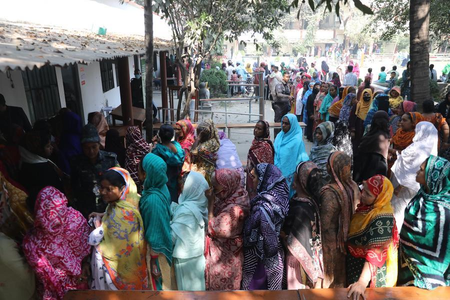
New Delhi, Feb 14 (IANS) In Bangladesh, several rights groups and media reports have highlighted the dearth of women candidates in the general election, despite the founding fathers and current leaders having pledged to make politics equally accessible to men and women.
In the run-up to the 13th national election, too, reports had flagged “systemic design and failure” as the main reasons. This year, a total of 51 political parties took part in Thursday’s election, where there are 1,981 candidates in the fray. Among them were only 86 women candidates, of whom seven won – six from the victorious Bangladesh Nationalist Party (BNP), and one independent.
“Political parties chose to nominate fewer women this time (in polls), as has been the trend earlier. Women’s rights activists had hoped that the rate of women’s nominations would increase in the wake of the July movement,” reported Bangladesh’s widely circulated newspaper ‘Prothom Alo’ on Saturday.
“However, despite strong objections from women’s rights activists, political parties agreed to nominate 5 per cent of their total candidates in their talks with the Jatiya Oikyamoto Commission (National Consensus Commission). However, the parties did not fulfil that promise,” it added.
According to reports, the Commission was formed in early February last year to review and adopt the recommendations submitted by the six key reform commissions set up by the Muhammad Yunus-led interim government.
Meanwhile, in order to let more women join the lawmaking process, Bangladesh had introduced reserved seats for women in parliament, which The Daily Star had earlier termed “an affirmative action strategy employed globally to rectify historical injustices and dismantle structural barriers. However, the objective of such measures is not permanence; rather, it is to build a society where women can compete and succeed on an equal footing with men.”
The June-end report last year stressed women entering parliament not with party patronage, but through public preference and political merit.
“We began with 15 reserved seats in 1972. Today, there are 50. On paper, this expansion signals progress. In practice, however, the structure and process of filling these seats – originally intended to amplify women’s voices – have become politically ornamental, elite-driven, and disconnected from public legitimacy. Instead of electing women based on public preference and political merit, the system centralises power in the hands of party leadership,” it analysed.
Tracing the history of women’s nomination, the Prothom Alo report quoted a research report by the Election Commission and Khan Foundation titled ‘Empowering Women Through Reserved Seats in Parliament: Fight or Flight Response?’, and newsletters of Democracy International, as well as the newspaper’s own reports.
“In the first national parliament (1973-1975), women representation was only in the then 15 reserved seats. In the second (1979-1982), there were a total of 32 women members of parliament, including 2 elected and 30 reserved seats. In the fourth parliament (1988-1990), there were no reserved seats, and there were 4 elected representatives. In the fifth, (1991-1995), there were 35 women members of parliament, including 5 elected representatives,” it recounted.
In the February 1996 general election, which the report termed as “BNP’s one-sided” exercise, “3 women were directly elected. There were 30 reserved seats,” it added.
The Khaleda Zia-led BNP government did not last long, and a snap poll was held in June when eight women were directly elected, bringing their total representation to 38.
In the subsequent polls, the number of reserved seats was increased to 45, while seven women in the eighth, and 21 in the ninth national election were elected.
“Thereafter, the number of reserved women seats was increased to 50. The total number of women members of parliament became 70. During the Awami League’s tenure, the elections of 2014, 2018, and 2024 were one-sided and contentious. In these three elections, 18, 23, and 19 women were elected, respectively,” the report said.
–IANS
jb/uk