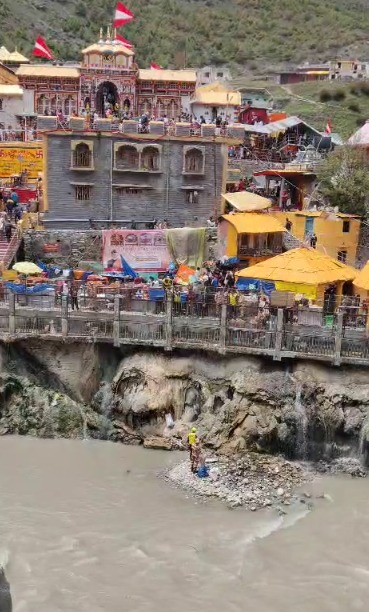
Badrinath Dham, May 8 (IANS) A joint cleanliness drive was conducted at the Badrinath Dham by personnel from the Police, ITBP, and SDRF on Friday under the pledge, “Clean Dham… Safe Dham.”
During the campaign, the personnel carried out extensive cleaning of the temple premises, the Tapt Kund, the riverbanks, and surrounding areas, spreading the message of hygiene and cleanliness among devotees and visitors.
In view of the continuously increasing number of pilgrims participating in the Char Dham Yatra, all personnel participated in the cleanliness drive with great enthusiasm and a strong sense of responsibility to maintain the sanctity and cleanliness of the holy shrine. Equipped with brooms and other cleaning tools, the personnel not only removed litter and waste but also created awareness among devotees about the importance of maintaining cleanliness.
During the drive, plastic waste, litter, and other garbage scattered across the temple premises and the Tapt Kund area were collected and disposed of at designated locations. A special cleaning operation was also carried out along the banks of the Alaknanda River to help preserve a clean and beautiful environment.
Appealing to devotees, personnel from the Police, ITBP, and SDRF emphasised that maintaining the sanctity of the holy shrine is a collective responsibility. They urged pilgrims to dispose of waste only at designated places and refrain from littering or spreading plastic waste in and around the temple premises.
Meanwhile, the Char Dham Yatra has witnessed a significant turnout this season, with more than 660,000 devotees completing the pilgrimage so far.
The Char Dham of Uttarakhand is one of the most revered Hindu pilgrimage circuits in the Indian Himalayas, located in the Garhwal region. The circuit comprises four sacred shrines—Yamunotri, Gangotri, Kedarnath, and Badrinath. These sites hold immense religious significance, with Kedarnath dedicated to Lord Shiva and Badrinath to Lord Vishnu, while Yamunotri and Gangotri are associated with the sacred rivers Yamuna and Ganga, revered as goddesses.
Traditionally, the Char Dham Yatra is undertaken from west to east, beginning at Yamunotri, followed by Gangotri, and then proceeding to Kedarnath and Badrinath. The pilgrimage was popularised by Adi Shankaracharya in the 8th century to revive Hindu spiritual traditions. Today, it continues to attract thousands of devotees from across the world, offering a deeply spiritual and enriching experience.
–IANS
jk/rad