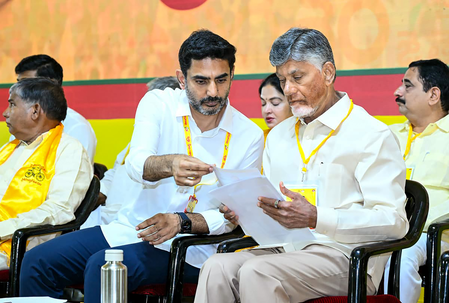
Amaravati, Sep 24 (IANS) Andhra Pradesh IT Minister, Nara Lokesh said on Thursday that the state government is adopting a holistic approach to ensure that data-centre growth is environmentally sustainable.
He said the state’s first thumb rule is that a minimum 70 per cent of the energy used by data centres must come from renewable sources, including solar, wind, pumped storage and battery-based energy.
Speaking at a fireside chat organised by the Public Affairs Forum of India (PAFI) in Delhi, he highlighted the state’s approach to developing data centres while addressing concerns over their environmental impact.
On water requirements, Minister Lokesh said the data-centre cluster is being developed in Visakhapatnam, and the state is addressing its water needs through the Polavaram Left Bank Canal.
According to a statement from the minister’s office here, he said the Polavaram project would help utilise water that would otherwise flow into the Bay of Bengal, with the water being moved towards Visakhapatnam to meet the requirements of data centres.
Minister Lokesh also said the state is incentivising data-centre companies to establish desalination plants, noting that one company is already setting up a desalination facility.
He stressed that addressing energy, water and other environmental requirements together is essential for sustainable data-centre development. Minister Lokesh said a holistic approach is required and that it would help states succeed in attracting and developing data-centre investments.
Lokesh also said that the state is developing 23 sector-specific clusters as part of its strategy to drive investment, innovation and job creation across the economy.
He said the clusters cover sectors ranging from traditional manufacturing such as cement and automotive to material sciences, rare earth minerals, biomedical, pharmaceuticals, AI and data centres. He highlighted the major investment being made by Google in Andhra Pradesh and said it is being followed by further investments in the data-centre sector.
Lokesh said quantum technology is also part of the 23-cluster strategy, with a quantum ecosystem being developed in Amaravati. Andhra Pradesh, he said, has taken the lead in bringing the first 150-qubit quantum computer from IBM to Amaravati. The state is also planning to build a wider ecosystem around quantum technology, covering areas from cryogenics and material sciences to quantum applications and use cases, including manufacturing.
Lokesh said the state is focussed on creating both blue and white-collar jobs, stressing that employment opportunities will be generated across sectors and skill levels. He also pointed to the hospitality sector, saying Andhra Pradesh aims to create 50,000 hotel rooms. He emphasised that skilling will be critical to meet the requirements of these diverse sectors.
He said Andhra Pradesh is currently a $200-billion economy and has set an ambition of becoming a $2.4-trillion economy by 2047. Achieving this, he said, requires the state to “fire across all cylinders” and develop every sector.
Minister Lokesh stressed that while quantum technology is important, horticulture and aquaculture are equally important to the state’s growth strategy. He announced that the Horticulture Mission will be launched on October 2, with close to ₹1 lakh crore of investment planned in research.
He also said Andhra Pradesh plans to develop an Indian School of Agriculture, modelled on the lines of the Indian School of Business in Hyderabad, with the aim of building a strong ecosystem for agricultural research and development.
–IANS
ms/rad