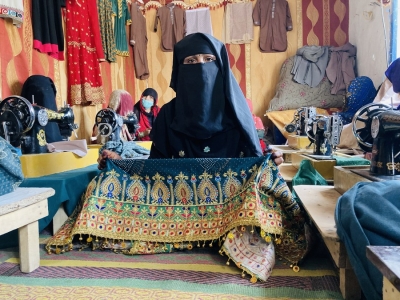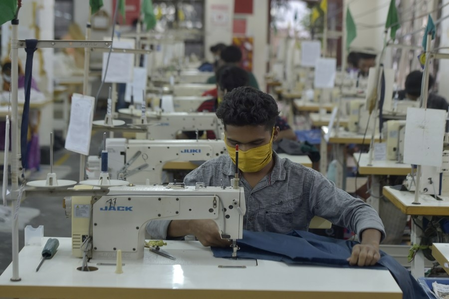
Dhaka, Nov 8 (IANS) The ban on Awami League in Bangladesh has left the future of the country’s garment workers into the dark, as the latter’s protests against rising inflation is being linked to the banned political outfit in Dhaka, resulting in their police detentions, according to a media report.
Following the change of government in Bangladesh in October 2024, the Mohammed Yunus-led interim administration banned the Bangladesh Chhatra League, the Awami League’s student wing, under the Anti-Terrorism Act (ATA).
On May 12, 2025, it imposed a “temporary” ban on the Awami League itself, using the newly amended ATA.
“Now it is being turned on garment workers striking for a wage they can live on. That is bad for democracy, and worse for an economy that cannot afford another crisis of trust,” Sangita Gazi said in her report in The Diplomat.
As hundreds of thousands of garment workers staged protests across several parts of the country on October 31, demanding a minimum wage of 30,000 Bangladeshi taka ($241), police detained 21 people who they called Awami League activists and not genuine workers.
Thousands more unidentified individuals were detained under the ATA, the report added.
Bangladesh Home Minister Salahuddin Ahmed reportedly blamed supporters of former Prime Minister Sheikh Hasina for the protests.
The detention of workers under ATA prompted many labour leaders to go into hiding.
According to the report in The Diplomat, videos and images circulating on social media appeared to show workers being beaten, and police raiding slums to round up protesters, alleging that they have links with the banned political party.
Refuting the allegations, workers have said that rising food prices, inflation, and energy costs drove them into the streets.
The mob violence and subsequent breakdown of law and order pushed the Bangladeshi economy to the “brink”.
“Between August 2024 and June 2026, 457 garment and textile factories closed, and more than 240,000 jobs were lost. Most of those who lost their jobs are women. For many, there is no other formal work, and some say employers now screen new hires for union ties.”
Moreover, according to a survey, the share of US buyers sourcing from Bangladesh fell to about 78 per cent from 88 per cent a year earlier.
According to Sangita Gazi, the current Bangladesh Nationalist Party (BNP)-led government is caught in a “real bind” as owners warn that higher wages will raise production costs and push buyers to Vietnam, India or Cambodia.
“One manufacturer’s leader called the 30,000 ‘taka’ demand one with ‘no logical or mathematical basis’,” she mentioned.
Therefore, the author cautioned that “when political participation is banned, the label becomes a weapon that an authority can use against anyone inconvenient”.
“Today that label is being used against workers asking for a wage that covers rent and rice. Tomorrow it could be students, journalists, or the BNP’s own critics,” Gazi warned.
–IANS
cg/khz