
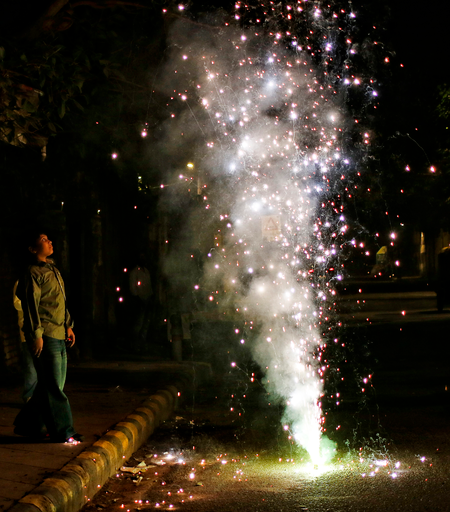
New Delhi, Nov 9 (IANS) The Chamber of Trade and Industry (CTI) has raised concerns over the ongoing debate surrounding the use of firecrackers in Delhi during Diwali, questioning whether an outright ban on their sale would guarantee better air quality in the national capital.
In a statement, CTI Chairman Brijesh Goyal said that engaging with firecracker traders and preventing them from selling crackers would effectively destroy their livelihoods.
He questioned whether any authority or institution could guarantee that Delhi’s Air Quality Index (AQI) would not cross the 300 mark between October and January, even if no firecrackers were burst during Diwali.
“The Chamber of Trade and Industry (CTI) wishes to clarify that we are firmly opposed to pollution; we want to see clean air in Delhi. However, it is unfair to hold firecrackers — used on a single day during Diwali — solely responsible for the pollution,” the traders’ body said in a statement.
“Shutting down the livelihoods of firecracker traders in the name of curbing pollution is not the solution,” it added.
Goyal pointed out that several firecracker traders in Delhi were associated with the organisation and said the CTI could persuade them not to set up stalls or sell firecrackers in the city next year. However, he questioned whether any credible and accountable authority or institution would guarantee that Delhi would remain pollution-free between October and January and that the AQI would not rise above 300.
Raising questions about the sources of pollution, the CTI chairman asked who was responsible for Delhi’s poor air quality on November 5, 6 and 7, when no firecrackers had been burst.
He pointed out that firecrackers were burst on November 8, but the AQI in Delhi had already remained between 350 and 400 on the three preceding days.
“This fact proves that firecrackers are not the root cause of pollution in Delhi. While it is easy to blame firecrackers, it is wrong to turn a blind eye to the facts,” Goyal said.
The CTI also questioned why pollution levels in Delhi consistently rise during the October-January period every year, while the situation remains comparatively different during the months from March to September.
“Everyone knows the answer — it is because, during these months, stubble is not being burned in the neighbouring states. As soon as the burning of stubble begins, Delhi starts to suffocate. As soon as it stops, the air in Delhi clears. This direct correlation is no secret. So, why is the blame placed on Diwali firecrackers every year, instead of taking action against stubble burning?” he questioned.
Describing the link between stubble burning and Delhi’s deteriorating air quality as an established fact, the organisation questioned why the focus continued to remain on Diwali firecrackers instead of stronger action against crop residue burning.
Highlighting the economic impact of restrictions on the firecracker industry, CTI said that around one million people across the country were associated with the sector. These included workers at manufacturing units in Sivakasi as well as retailers and small shopkeepers selling firecrackers in Delhi and other parts of the country.
The organisation said that manufacturers and traders had invested substantial amounts of money and obtained the required legal licences and stock. Small traders, in particular, invest their capital throughout the year and depend on the 15-20 days around Diwali to earn a significant portion of their annual income.
“A last-minute ban causes their entire investment to be wiped out. Even when traders have manufactured ‘green crackers’ in compliance with court directives, why do they continue to be targeted repeatedly?” Goyal said.
The organisation further raised concerns about the impact of restrictions on children’s celebrations, saying that Diwali was an occasion children looked forward to throughout the year.
Instead of imposing a complete ban, the organisation advocated a “balanced approach” involving “reduced use of firecrackers, adherence to designated time slots and the promotion of approved ‘green crackers'”. It said such measures would help address environmental concerns without completely taking away the joy associated with the festival.
The CTI also questioned what it described as the selective application of environmental restrictions to Hindu festivals. Clarifying that it was not opposed to any religion and respected all faiths, the organisation said it had the right to raise questions about why stringent restrictions in the name of environmental protection were frequently imposed on Hindu religious celebrations.
“Whether it is firecrackers on Diwali, the use of water during Holi, concerns regarding the Yamuna during Chhath, the use of DJs during the Kanwar Yatra, or pollution during the immersion of Ganpati idols — why is it that regulations, bans, and legal petitions are almost always directed first and foremost at Hindu festivals?” the CTI said.
“Meanwhile, firecrackers are set off across the country at midnight on New Year’s Eve; why are no such concerns raised then? In the name of tradition and religion, millions of litres of blood are washed away — yet no one raises a voice. However, Diwali, the most significant festival of the Sanatan tradition, is consistently singled out and targeted,” it added.
The CTI asked whether anyone could guarantee that Delhi’s AQI would remain below 300 between October and January if the use and sale of firecrackers were completely prohibited. “If not, then why should firecracker traders be penalised?” it added.
“We want a balance: clean air, thriving businesses, the preservation of traditions, the continued joy of children, and a legal framework that applies equally to all. The solution to pollution does not lie in selective bans, but rather in scientific and balanced management throughout the year,” Goyal said.
–IANS
sd/mr