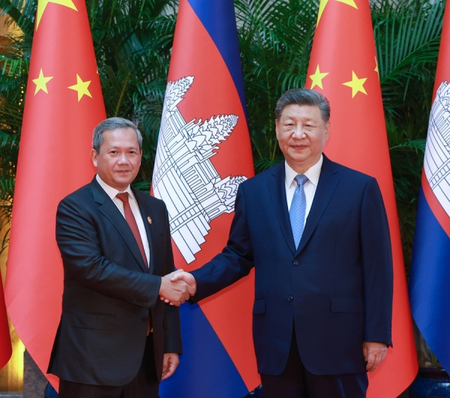
Beijing, Aug 24 (IANS) China’s ‘ironclad friendship’ with Cambodia, is subordinate to Beijing’s national interests, implying that Phnom Penh should view friendship as a diplomatic instrument instead of insurance against territorial loss, a report has detailed.
Artillery, rockets and airstrikes began along the Cambodia-Thailand border on July 24, last year – a test of Cambodia’s ‘ironclad friendship’ with China. It became more severe when the fighting between Cambodia and Thailand again started on December 27. Despite the tensions between the two nations, China did not endorse Cambodia’s territorial claims and did not condemn Thailand’s actions. In its statement, the Chinese Foreign Ministry described Cambodia and Thailand as friendly nations and took a neutral stance, according to a report in Eurasia Review.
In its statement released on July 27, 2025, the Chinese Foreign Ministry spokesperson stated, “Cambodia and Thailand are and will always be each other’s neighbours. Both countries are China’s friends and neighbours as well. Maintaining good-neighbourliness and mutual trust and properly managing differences serves the two countries’ fundamental and long-term interests, and the region’s peace and stability.”
The spokesperson said that China was saddened by the casualties inflicted on both sides and expressed hope that the two nations will bear in mind the interests of the two peoples, cherish peace and good-neighbourliness, exercise calm and restraint, reach a ceasefire as soon as possible and settle differences peacefully through dialogue and consultation. The spokesperson also described Cambodia and Thailand as important members of ASEAN.
“Beijing’s diplomatic rhetoric of friendship is subordinate to the national interest. Cambodia is still valuable as it provides political alignment, strategic access, and diplomatic support. Thailand, however, is more economically significant, more influential in mainland Southeast Asia and has a significant defence relationship with China. Cambodia’s rhetorical status was not enough to secure exceptional Chinese support when the relationships came into tension,” Channtha So, a PhD Candidate in International Relations at The University of Cambodia, mentioned in a report in Eurasia Review.
The tensions along the Cambodia-Thailand border was a practical test of China’s ‘ironclad friendship’. China did not leave Cambodia; however, it did not let friendship determine its interests. China continued to have political and military ties with Cambodia and Thailand, and the higher cost of Bangkok made it difficult for Beijing to prioritise Phnom Penh. For China, the regional position, commercial scale, and defence ties with Thailand were more important than Cambodia’s rhetorical status, the report mentioned.
“Beijing’s subsequent attempts to pacify Cambodia do not overturn this assumption because it maintained a beneficial, but highly asymmetric relationship with Cambodia without limiting China’s strategic options. The real principle of the Chinese ironclad is the protection of national interest. Therefore, Cambodia should consider friendship as a diplomatic instrument rather than an insurance against territorial loss. Strategic autonomy necessitates Phnom Penh to distinguish between praise and obligation, minimise dependence and establish alternative options that are not based on the affection of another state,” Channtha So mentioned in a report in Eurasia Review.
–IANS
akl/as