
‘Complete shutdown’: Nationwide chemists’ strike against online pharmacy sales


New Delhi, May 24 (IANS) Congress on Saturday fully backed the External Affairs Minister (EAM) S. Jaishankar, who delivered a strong message during his official visit to Germany, asserting that India will never yield to nuclear threats and will continue to handle issues with Pakistan on a bilateral basis.
Jaishankar’s statement received rare bipartisan support back home, with leaders across party lines endorsing his firm diplomatic tone.
Congress leader Sandeep Dikshit welcomed the statement, saying: “Absolutely right. We have always had this right, and I would also expect that when we are engaging with countries like Germany, we seek their support against Pakistan as well. What Pakistan does, what its economy is like, that’s their concern. We’ve always said that we want good relations with all our neighbours.”
He added that for the past 30–35 years, the way Pakistan has promoted terrorism, these are outright criminal acts, crimes against humanity.
“These countries should also identify Pakistan as a rogue state and act accordingly,” he said.
Meanwhile, echoing a similar sentiment, Shiv Sena (UBT) spokesperson Anand Dubey said that EAM Jaishankar is India’s External Affairs Minister and an expert in diplomatic affairs.
“If he is stating in Germany that India will not tolerate terrorism at any cost and won’t succumb to Pakistan’s repeated nuclear threats, then this reflects not just the stand of the opposition, but the sentiment of the entire nation and our armed forces,” he said.
EAM Jaishankar’s remarks came days after the deadly Pahalgam terror attack on April 22 and India’s decisive response through Operation Sindoor.
Speaking alongside German Foreign Minister Johann Wadephul during a joint press conference, EAM Jaishankar said: “I come to Berlin in the immediate aftermath of India responding to the Pahalgam terror attack. India has zero tolerance for terrorism. India will never give in to nuclear blackmail, and India will deal with Pakistan purely bilaterally. There should be no confusion in any quarter in that regard. We also value Germany’s understanding that every nation has the right to defend itself against terrorism.”
Germany also expressed solidarity with India in the fight against terrorism, with Minister Wadephul affirming Berlin’s support and acknowledging India’s right to defend its citizens and sovereignty.
–IANS
rs/dan

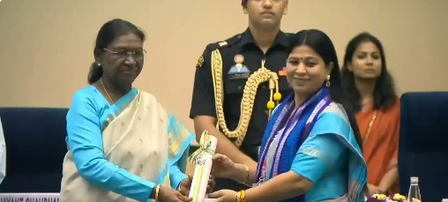
New Delhi/Bhopal, Sep 5 (IANS) President Droupadi Murmu on Saturday honoured six teachers and educationists from Madhya Pradesh with the National Teachers’ Awards 2026 for their contribution to education, skill development, innovation and research on the occasion of Teachers’ Day.
The six awardees are Archana Shukla, Shailendra Pratap Singh, Sangeeta Yadav, Sourav Datta, Reena Gupta and Jyotibala Rathore.
Shukla, a science and biology teacher, has worked for 15 years in project-based learning, environmental conservation and student guidance. Her initiatives include installing more than 1,000 sparrow houses, QR-code-based digital mapping of trees on a school campus and the ‘Plant Emotion’ project.
Singh, an English teacher and in-charge headmaster, transformed resource-constrained schools through community participation. His efforts increased student enrolment from 69 to 202 and attendance from 44 per cent to 96 per cent. He has also worked to prevent child marriage, bring school dropouts back into education and facilitate schooling for children with disabilities.
Yadav has promoted innovative, activity-based mathematics teaching through programmes, including Ganitotsav, Quest for Mathematics, Mathemind and Bagless Mathematics Day.
Datta, a plant biologist at IISER Bhopal, was recognised for encouraging research-oriented thinking among students. He has twice received the IISER Bhopal Distinguished Teacher Award and has undertaken research on developing plants resilient to climate change.
Gupta, a training officer at Government Divisional ITI in Ujjain has trained hearing- and visually-impaired trainees in computer and digital skills for 16 years, helping them become employable and self-reliant.
Rathore, a training officer at the National Skill Training Institute (Women) in Indore, has six years of industrial and 19 years of teaching experience. Her trainees have performed well in national and state-level competitions, while she has also helped secure employment opportunities for them.
Chief Minister Mohan Yadav congratulated the six awardees, saying their national recognition was a matter of pride for Madhya Pradesh.
He said that teachers were not merely disseminators of knowledge but builders of the future of society and the nation.
On this occasion, the Madhya Pradesh government felicitated 33 teachers at the State-Level Teachers’ Felicitation Ceremony 2026 at the RCVP Noronha Academy of Administration and Management in Bhopal in the presence of Governor Mangubhai Patel and Chief Minister Mohan Yadav.
–IANS
pd/khz


New Delhi, June 23 (IANS) National Human Rights Commission (NHRC) Chairperson Justice (Retd) V. Ramasubramanian on Tuesday virtually participated in the First Consultative Meeting of National Human Rights Institutions, State Bodies and other Organisations of the Shanghai Cooperation Organisation (SCO) member states.
The event was held in Bishkek, Kyrgyz Republic and NHRC Secretary General Bharat Lal and Joint Secretary Samir Kumar were also present.
The meeting was attended by the Ombudsperson of the Kyrgyz Republic, the Deputy Secretary-General of the SCO, Chairpersons and Heads of National Human Rights Institutions (NHRIs) and other relevant bodies from Russia, China, Iran, Pakistan, Uzbekistan, Kazakhstan, Tajikistan and Belarus, along with distinguished delegates and experts.
Justice Ramasubramanian commended the Kyrgyz Republic for its leadership in convening the first consultative meeting under its SCO Chairmanship.
He said that the proposal for regular consultative interaction among NHRIs and related bodies is both timely and forward-looking. It would promote meaningful dialogue, mutual understanding and practical cooperation in addressing contemporary socio-economic and geo-political challenges.
He emphasised that NHRIs play an important role in strengthening trust between the State and society and fostering social stability.
He underscored that regional cooperation should be guided by the principles of respect for State sovereignty, non-interference in internal affairs, equality and mutual consideration of national interests.
The NHRC Chairperson welcomed the objectives contained in the draft protocol relating to the exchange of information, dissemination of best practices, expert cooperation and development of coordinated approaches to human rights issues.
He noted that regular exchanges among institutions would facilitate mutual learning and enhance institutional effectiveness.
Justice Ramasubramanian highlighted NHRC’s Indian Technical and Economic Cooperation (ITEC) Capacity Building Programme for NHRIs and the value of structured learning, dialogue and cross-border engagement in strengthening institutional capacities.
He reaffirmed NHRC India’s support for deeper cooperation within the SCO framework and expressed confidence that the consultative mechanism would evolve into an important platform for dialogue, cooperation and exchange of experiences among institutions dedicated to the promotion and protection of human rights and freedoms.
–IANS
rch/uk