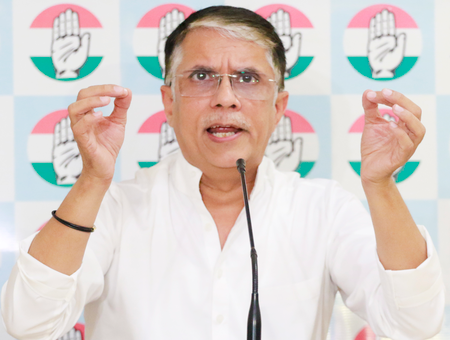
Congress has submitted 89 lakh complaints to ECI: Pawan Khera on Bihar SIR exercise


Chandigarh, Nov 22 (IANS) In a major blow to Pakistan’s ISI-backed trans-border drug trafficking module, Punjab Police’s Anti-Narcotics Task Force (ANTF) has arrested a drug smuggler and recovered 50 kg heroin from his possession, said Director General of Police (DGP) Gaurav Yadav here on Saturday.
The accused has been identified as Sandeep Singh, alias Seepa, a resident of Shanna Sher Singh Wala village in Kapurthala.
Apart from recovering a big haul of heroin, police teams have also impounded his white Kia Seltos, in which he was travelling.
DGP Yadav said preliminary investigation has revealed that the trans-border shipment of 50 kg heroin was sent by Pakistan-based ISI-supported smugglers.
He said the accused is a history-sheeter with eight criminal cases, including five under the NDPS Act, registered against him, indicating his deep involvement in organised drug trafficking. He was recently released from Kapurthala Jail.
The DGP said further investigations are ongoing to establish linkages in this case, and more recovery is likely.
Sharing operational details, Additional Director General of Police (ANTF) Nilabh Kishore said that acting on precise technical intelligence, ANTF teams were tracking the movement of the accused after he came out of jail earlier this month. Intelligence suggested that the suspect had collected a heavy consignment of contraband from the border village of Baggeke Utar in Jalalabad, he said.
Acting swiftly, ANTF teams spotted the suspect driving towards Ferozepur, and upon being challenged, he attempted to evade arrest, leading to a pursuit by the police team, said the ADGP, adding the suspect was eventually intercepted at Rauke village following a brief encounter where he tried to run his vehicle over the police party.
He said the probe is on to identify the intended recipients of this consignment. A case has been registered under Section 21 of the NDPS Act at the ANTF Police Station in Mohali.
–IANS
vg/uk


New Delhi, April 17 (IANS) Dravida Munnetra Kazhagam (DMK) MP Kanimozhi Karunanidhi on Friday launched a strong counter to the government’s defence of three proposed legislations, including women’s reservation bill in Parliament, for the operationalization of women’s quota and accused of it using the cause to “safeguard” its own political future by redrawing the electoral map of the country.
Joining the debate in Lok Sabha, the DMK MP questioned the timing, intent and motive of the government behind calling a special session of Parliament and bulldozing the Opposition’s concerns and apprehensions.
She slammed the Centre for ‘stalling’ the implementation of women’s reservation despite Parliament’s unanimous approval in 2023, and now uses it as a front for furthering their political agenda.
Questioning the linkage of delimitation with reservation, she said that the BJP-led government at the Centre is not serious and considerate towards women’s cause, and it is rewarding itself by using the 2011 Census data as a basis for delimitation.
“It is politically convenient for them to redraw the political map of the country by introducing delimitation from the back door,” she said.
Stating that the Opposition parties pressed the government to hold a Parliament session after elections, but the latter dismissed all requests.
“For decades, you didn’t show any urgency in implementing it. But today you are blaming the Opposition for the delay. This is not electoral reform but an electoral rescue strategy because of your fear of fairing poorly in upcoming elections,” Kanimozhi said.
The DMK leader refused to buy Home Minister Amit Shah’s assurances on maintaining the status quo on the Southern state’s share in the Lok Sabha and also took a swipe at Prime Minister Narendra Modi’s “civilisational commitment” promise.
She said that linking delimitation to women’s reservation is a trap and is designed to blame the Opposition if the proposed legislation gets stalled.
“I ask the Home Minister — why can’t you give a reservation by simply delinking the reservation from delimitation. Why can’t you give a reservation in the existing number of seats?” she asked.
“The Prime Minister called it civilisational commitment, but I must state that women have been protecting families, they die for the nation, but their sacrifices have remained unnoticed for decades,” she added.
“This bill looks like a prelude and facilitator to your future political goals. This balance is ambiguous, misleading and serves no real purpose,” she remarked.
Pointing to the Home Minister’s assurances to parties that delimitation won’t affect the state’s legislative representation in Parliament, she demanded that these assurances be made part of the draft legislation.
“Records show that this government’s 80 to 90 per cent assurances have never been seen through; hence, we can’t buy your words,” she said.
On the black colour jibe at the DMK for protesting against the bill, they said that they will not bow down to the government’s diktats and would stand up to them to safeguard women’s rights.
–IANS
mr/dpb


New Delhi, Dec 10 (IANS): There has been a sustained growth of the startup ecosystem in the country with the Department for Promotion of Industry and Internal Trade (DPIIT) listing as many as 2,01,335 startups for incentives under the Startup India initiative which have created over 21 lakh jobs across the country, according to a year-end review released by the Commerce and Industry Ministry on Wednesday.
In the spirit of Nari Shakti, there has been a significant contribution of women entrepreneurs in the transformation of the Indian startup landscape, the ministry said in the review. More than 48 per cent of the recognised startups in India have at least one woman director.
It further highlights that domestic patent filings by Indian innovators increased by 425 per cent during 2014-2024, and India’s rank in the Global Innovation Index has improved to 38th in the GII 2025 ranking.
The review also states that the Open Network for Digital Commerce (ONDC), which aims to democratise e-commerce in India, is expected to make digital commerce inclusive and accessible for all, unlock innovation for all players in the e-commerce ecosystem and bring out potential benefits for all stakeholders in the e-commerce value chain.
ONDC has processed a cumulative of 326 million+ orders as of October 2025. Further, in the month of October 2025, 18.2 million orders have been processed, and average daily transactions have reached approximately 5,90,000, the review states.
One District One Product (ODOP) initiative aims to foster balanced regional development across all districts of the country by selecting, branding, and promoting One Product from each District (One District – One Product) of the country. Over 1,240+ products have been identified across 775 districts.
The review underlines the importance of PM Ekta Malls, which provide capital assistance to states for the creation of Unity malls in all states to promote ODOP products. Of the 27 states whose DPR for PM Ekta Mall has been approved, 25 states have issued work orders, and construction has started in the majority of States.
In order to enhance the ease of doing business, more than 47,000 compliances have been reduced, and 4,458 provisions have been decriminalised. As many as 8,29,750 approvals have been granted through the National Single Window System so far.
The review further states that keeping in view India’s vision of becoming ‘Aatmanirbhar’ and to enhance India’s manufacturing capabilities and exports, Production Linked Incentive (PLI) schemes have been launched for 14 key sectors with an outlay of Rs. 1.97 lakh crore.
Actual investment of over Rs. 1.88 lakh crore has been realised till June 2025 across 14 sectors, which has resulted in incremental production of over Rs 17 lakh crore and both direct and indirect employment generation of over 12.3 lakhs.
PLI Schemes have witnessed exports exceeding Rs 7.5 lakh crore with significant contributions from sectors such as electronics, pharmaceuticals, telecom & networking products and food processing.
Launched in October 2021, PM GatiShakti (PMGS) is a National Master Plan (NMP) for multi-modal connectivity. It integrates infrastructure planning across multiple ministries (roads, railways, ports, aviation, inland waterways, energy, etc.) to reduce silos and avoid duplication. As many as 57 ministries and departments have been onboarded on the PMGS.
Similarly, the Unified Logistics Interface Platform (ULIP), developed under the National Logistics Policy, is a digital integration layer that breaks ministerial data silos and facilitates seamless data exchange among stakeholders across the logistics ecosystem. Currently, ULIP has been integrated with 44 systems of 11 ministries.
–IANS