
New Delhi, Oct 17 (IANS) Delhi has achieved a significant milestone in its efforts to improve air quality, recording 211 days of Good, Satisfactory and Moderate Air Quality as of October 17, marking its best performance since 2016, except for the COVID-affected year 2020, said the city’s Environment Minister, Manjinder Singh Sirsa.
Significantly, with more than two months of the year remaining, Delhi has already surpassed the total number of Good-to-Moderate air quality days recorded during the entire year in most previous years, including 200 days in 2025, 209 days in 2024, 206 days in 2023, 159 days in 2018 and 110 days in 2016, he said.
He said under the leadership of Chief Minister Rekha Gupta, the Delhi government has adopted a comprehensive, coordinated and result-oriented approach towards combating air pollution, and the sustained efforts of various agencies and stakeholders are beginning to show positive outcomes.
The Minister highlighted that the number of Poor, Very Poor and Severe air quality days during the corresponding period has also declined substantially, from 168 days in 2016 to just 79 days in 2026.
Meanwhile, the Commission for Air Quality Management in NCR and Adjoining Areas (CAQM) reviewed enforcement actions, inspection findings and compliance status across the National Capital Region (NCR) at the 141st meeting of its Enforcement Task Force (ETF), held on Friday.
During the 15-day reporting period from September 25 to October 9, a total of 124 inspections were reported, comprising six inspections at Construction and Demolition (C&D) sites, 54 in the industrial sector and 64 related to Diesel Generator (DG) sets. These inspections resulted in 55 reported violations, including five at C&D sites, 35 in the industrial sector and 15 related to DG sets, said a statement issued by the Union Ministry of Environment, Forest and Climate Change.
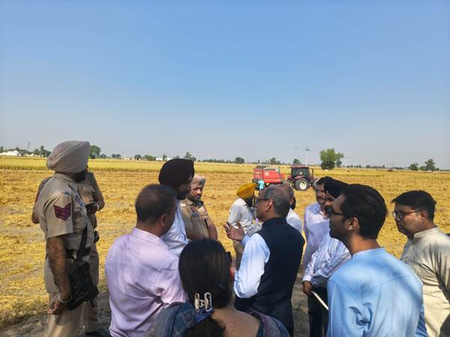
In a separate development, a team led by T.S. Panwar, Member (Technical), CAQM, visited Firozpur and Faridkot districts in Punjab on Saturday to review the ground-level implementation of measures to prevent paddy stubble burning during the ongoing harvesting season.
During the meeting, the team reviewed the preparedness of the district administrations and coordination among concerned departments for effective in-situ and ex-situ management and utilisation of paddy stubble.
The availability and deployment of Crop Residue Management (CRM) machinery, field-level surveillance, monitoring of hotspot areas and enforcement measures were also reviewed, the statement said.
The team emphasised the need to strengthen in-situ and ex-situ management of paddy straw, ensure timely availability and optimal utilisation of CRM machinery, and enhance coordination among farmers, aggregators, industries and other stakeholders. The deployment of drones and low-cost sensors for technology-based monitoring and trend analysis was also reviewed, along with efforts to sensitise farmers about the ill effects of stubble burning and PM2.5.
–IANS
rch/dan