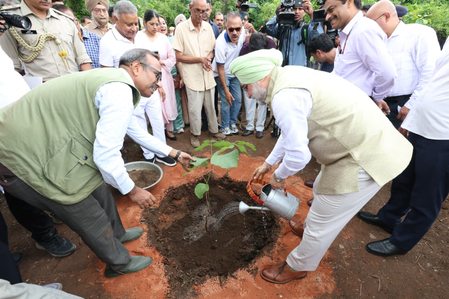
New Delhi, July 31 (IANS) Delhi Lieutenant Governor Taranjit Singh Sandhu on Friday planted native saplings at Kamla Nehru Ridge in North Delhi as part of DDA’s single-day drive under which one lakh trees and shrubs were planted across 77 locations, an official said.
Sandhu was joined by over 200 participants, including students from four colleges – St. Stephen’s, Hindu, Hans Raj, Maharishi Valmiki; two schools – Mamta Public School (Vikas Puri), Govt. Girls Sr Sec School (Shakti Nagar); morning walkers, and about 20 Resident Welfare Association (RWA) members, in the plantation initiative, said an official statement.
The Lieutenant Governor directed the Delhi Development Authority (DDA) to make such plantation drives a regular practice and to replicate the model across other Ridges in Delhi.
He said that such exercises should be driven by the youth and should be aimed at them, underlining that this would go a long way in making the future generations stakeholders in preserving and restoring ecology.
Sandhu underlined that it is the responsibility of the present generation to hand over an ecologically rich Delhi to those who come after.
The LG directed that DDA must play an important and proactive role in increasing Delhi’s green cover, going beyond one-off drives to build a sustained, youth-led movement for ecological restoration across the Capital.
Sandhu directed the DDA to appoint Nodal Officers for each plantation site, who would be tasked with the responsibility of ensuring that the saplings survive and grow into trees. These Nodal Officers will also be held accountable for the same, said the statement.
Vice Chairman, DDA, along with senior officers of the Authority, also participated in the programme, reflecting their commitment to promoting community participation in environmental conservation.
The plantation at Kamla Nehru Ridge included indigenous species such as Anogeissus pendula (Dhok), Cassia fistula (Amaltas), Butea monosperma (Dhak) and Gmelina arborea (Gamhar), all of which are well adapted to Delhi’s ecology and contribute significantly to strengthening biodiversity, improving wildlife habitats and enhancing the long-term ecological resilience of the Ridge, said the statement.
–IANS
rch/uk