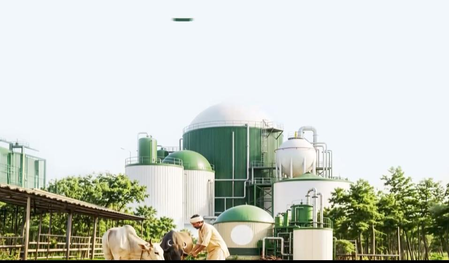
Gandhinagar, Aug 25 (IANS) Gujarat will add 20,000 new household biogas plants in 2026-27, expanding a programme that converts cattle dung and other organic waste into clean cooking fuel and organic fertiliser while reducing rural households’ dependence on LPG.
The new 2-cubic-metre flexible biogas plants will be installed with the support of the state’s extensive dairy cooperative network, including Amul, Banas Dairy, Dudhsagar Dairy and the National Dairy Development Board (NDDB).
The initiative is being implemented under the GOBARDhan scheme of the Swachh Bharat Mission (Gramin). More than 14,000 biogas plants are already operational across 88 clusters in Gujarat.
The state has adopted a cluster-based approach to expand the programme, with the first phase covering 7,423 plants across 38 clusters, supported by NDDB, Amul, Banas Dairy and Dudhsagar Dairy.
A second phase targeted another 10,000 plants across 50 clusters, with nearly 7,000 plants established in partnership with the Gujarat Cooperative Milk Marketing Federation and district milk unions.
Under the new expansion, livestock farmers will receive financial assistance of Rs 25,000 per plant through the Swachh Bharat Mission (Gramin).
The plants convert cattle dung into cooking gas, while the resulting bio-slurry can be used as organic fertiliser.
According to figures cited by the Gujarat government from a UNICEF survey, a 2-cubic-metre biogas plant can save the equivalent of eight to 10 LPG cylinders a year, manage around 18,250 kg of livestock waste annually and reduce carbon dioxide emissions by approximately 834 kg.
Sangram Chaudhary, managing director of Banas Dairy, said renewable and clean energy could help address environmental concerns.
“Renewable and clean energy protects the ozone layer from the damage caused by climate change. At the same time, the use of compressed CNG helps us reduce carbon emissions, which are a major cause of global warming,” he said.
The programme is also creating an additional income source for livestock rearers by linking them to commercial biogas projects.
In Banaskantha, Banas Dairy has established a commercial biogas plant and is purchasing cattle dung from livestock farmers in surrounding villages.
Ramji Chaudhary, a livestock farmer from Banaskantha, said his family used to use the dung for farming but now sends it to the plant. “Since the plant was established, we have been sending all the cow dung there. A tractor comes from the dairy every day and collects the cow dung,” he said.
Another livestock farmer, Rinku Chaudhary, said income from dairy activities and the biogas plant had helped her family.
“The income from the dairy, the income from milk and the income from the biogas plant are all helping our children and us greatly. The standard of living of our children has also improved,” she said.
The state government says using bio-slurry as organic fertiliser can reduce farmers’ dependence on chemical fertilisers and improve soil fertility.
The programme is therefore being linked not only to clean cooking fuel and livestock-waste management, but also to agricultural use of the residue generated during biogas production.
Gujarat’s expansion comes as the Centre has also approved the National Circular Bioenergy Scheme — GOBARDhan, with a total outlay of Rs 23,731 crore, to promote the conversion of organic waste into bioenergy and bio-fertilisers.
The state government said expanding household biogas plants will support rural sanitation, renewable energy use, and cattle dung management, while helping reduce emissions and household spending on conventional cooking fuel.
–IANS
mys/dan