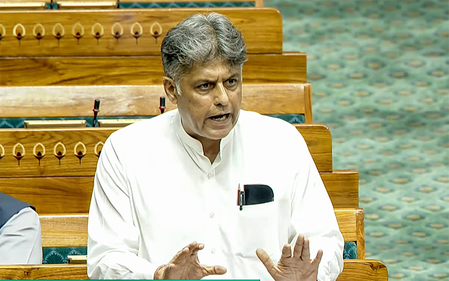
New Delhi, July 27 (IANS) Congress MP Manish Tewari on Monday submitted an adjournment motion notice in the Lok Sabha, seeking a discussion on the need for a new anti-defection law to address what he described as mass political defections driven by opportunism while safeguarding genuine ideological dissent.
In a notice submitted to the Secretary-General of the Lok Sabha during the ongoing Monsoon Session of Parliament, Tewari urged the House to suspend its scheduled business to deliberate on the issue.
“I hereby give notice of my intention to ask for leave to move a motion for the adjournment of the business of the House for the purpose of discussing a definite matter of urgent importance,” Manish Tewari said in a notice submitted to the Secretary-General of the Lok Sabha.
He further said, “I move that this House do suspend Question Hour, Zero Hour and all other listed business of the day to discuss the need for a New Anti-Defection Law that proscribes Mass Political Defections driven by opportunism and bereft of any genuine ideological or policy differences while simultaneously providing space for honest and critical dissent both inside and outside Parliament and the legislatures.”
Tewari also appealed to the government to allow a full-fledged discussion on the issue.
“I therefore urge the government to adjourn the business for today and allow a full discussion on this matter of urgent importance,” he said.
His demand comes at a time when debates over the effectiveness of the existing anti-defection law have intensified across the political spectrum, with several recent legal and political developments reigniting calls for reforms.
Senior advocate and Rajya Sabha MP Kapil Sibal recently approached the Supreme Court by filing a writ petition in his personal capacity, challenging the interpretation of the Tenth Schedule of the Constitution. Sibal argued that the present legal interpretation of provisions relating to political mergers has weakened the anti-defection framework.
“I have filed a petition in person. It relates to the issue of whether the composition of Parliament can change in the fashion in which it’s happening in this country and the interpretation of the Tenth Schedule paragraph 4 in that context,” Sibal told a Bench led by Chief Justice of India Surya Kant.
Last month, Shiv Sena leader and Maharashtra Deputy Chief Minister Eknath Shinde had announced that six Lok Sabha MPs from the Shiv Sena(UBT) faction had joined the Shiv Sena. Addressing a press conference in Mumbai, Shinde had welcomed the MPs — Sanjay Dina Patil, Sanjay Deshmukh, Sanjay Jadhav, Bhausaheb Wakchaure, Nagesh Patil-Ashtikar and Omprakash Raje Nimbalkar into the party.
Earlier in April, seven rebel Rajya Sabha parliamentarians from the Aam Aadmi Party were officially inducted into the Bharatiya Janata Party, as the Rajya Sabha Secretariat updated party positions in the Upper House. Raghav Chadha, along with six MPs, left AAP and had decided to merge with the BJP after being removed from the post of deputy leader in the Rajya Sabha last month.
In Subhash Desai versus Principal Secretary, Governor of Maharashtra, i.e., the Shiv Sena split case (2023), the Supreme Court distinguished between a “legislative party” and a political party, saying they cannot be conflated. Now, the joining of another party is not a valid defence in disqualification proceedings under the Tenth Schedule unless the original political party itself merges with another party.
The anti-defection law is contained in the Tenth Schedule of the Constitution, introduced through the 52nd Constitutional Amendment in 1985 during the Rajiv Gandhi government.
Its objective was to prevent elected representatives from switching political loyalties after elections in exchange for ministerial positions or other political gains — a practice that had become rampant during the “Aaya Ram, Gaya Ram” era of the 1960s and 1970s.
Under the existing law, an MP or MLA can be disqualified if they voluntarily give up membership of the political party on whose ticket they were elected, vote or abstain from voting against the party whip without prior permission, if an independent member joins a political party after being elected, or if a nominated member joins a political party more than six months after entering the legislature.
–IANS
jk/dpb