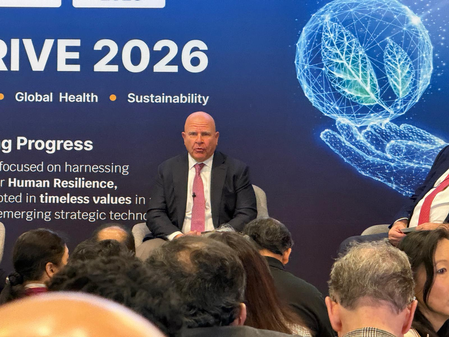
Washington, April 18 (IANS) Former US National Security Adviser Lt Gen (rtd) H. R. McMaster said the United States and its allies must move quickly to secure critical technologies and supply chains as strategic competition with China intensifies.
Speaking at a panel discussion at the Thrive 2026 conference at Stanford University, McMaster said years of globalisation had left Western economies exposed by prioritising efficiency over resilience. “We became complacent,” he said, warning that supply chains are now vulnerable in a period of renewed great power rivalry.
“China in particular has weaponised its status as a marketplace economic model against our free market economies,” McMaster said, adding that the challenge spans artificial intelligence, supercomputing, energy and material sciences.
He described the competition as part of a broader effort by China and others to reshape global rules. These actors, he said, seek to replace the current system with one aligned to “their authoritarian form of government.”
On emerging technologies, McMaster said it would be difficult to establish shared global standards. “It’s unrealistic to assume that the Chinese Communist Party leadership will sign up… for the rules that we would think are in our interests,” he said.
He urged companies and investors to adopt stricter safeguards. He proposed a “Hippocratic oath” for boardrooms to ensure firms do not aid adversaries or undermine long-term interests.
“Don’t help our potential enemies develop weapon systems… Don’t help an authoritarian regime extinguish human freedom… and don’t compromise the long-term viability of your company,” he said.
McMaster pointed to past US investments in Chinese firms linked to military and surveillance systems as examples of the risks involved. He said intellectual property theft and state-backed competition remain persistent concerns.
He also highlighted weaknesses in supply chains for critical minerals. Environmental regulations in the West, he said, had pushed processing capacity to China.
“A lot of people were well motivated… they just exported the pollution to China,” he said, calling for new investment in extraction and refining technologies.
McMaster said rebuilding supply chains would require coordination with allies. He cited sectors such as shipbuilding and semiconductors where multinational cooperation is essential.
At the same time, he cautioned against restricting academic exchanges. Limiting foreign students in US universities would be a “tremendous mistake,” he said, while calling for tighter screening in sensitive research areas.
On Taiwan, he warned that the risk of disruption to semiconductor supplies is rising. Any blockade or coercive action by China would be “a disaster for the global economy,” he said.
McMaster said governments may need to act where markets fall short. “It’s free market versus the public good of national security,” he said, adding that some economic costs may be unavoidable.
–IANS
lkj/dan