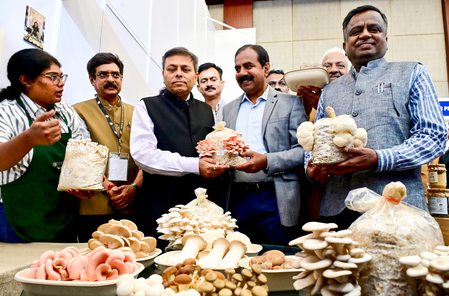
New Delhi, Nov 10 (IANS) Mushroom cultivation can extend beyond an additional farm activity to become a pathway for livelihood diversification and entrepreneurship, according to a government factsheet on Tuesday.
When supported by appropriate training, technical guidance, and productive infrastructure, it can help farmers make better use of limited land and resources while creating opportunities for additional income.
With growing interest in healthier diets, mushroom cultivation is gaining importance in India’s horticulture sector and offers scope for further growth.
Mushrooms are valued for their nutritional profile, being generally low in calories, fat, and carbohydrates while providing protein, dietary fibre, vitamins, and minerals. They can be cultivated with limited land and in rural, urban, and peri-urban settings.
Across India, mushroom cultivation is emerging as a viable livelihood option for farmers, women, and rural youth.
“For Ruthu of Ippatam village in Guntur district, Andhra Pradesh, the journey began with a search for an alternative source of livelihood. At the age of 20, she was working as a waste picker and aspired to establish an independent livelihood,” according to the factsheet.
This opportunity emerged through a short-term training programme under the Skill Training for Rural Youth (STRY) initiative. Krishi Vigyan Kendra (KVK), Guntur, provided training in mushroom production, covering key stages such as composting, spawning, casing, pinning, cropping, and harvesting.
The programme was conducted with support from the State Agricultural Management and Extension Training Institute (SAMETI), Andhra Pradesh, and the National Institute of Agricultural Extension Management (MANAGE), Hyderabad.
Applying the skills acquired during the training, Ruthu began cultivating milky mushrooms and established a regular supply to the local market.
Her production reached approximately 8 kg per day, generating a monthly income of around Rs 35,000. She has also learnt the importance of using clean paddy straw free from disease and good-quality spawn, while maintaining the right temperature and moisture levels during cultivation.
In Uttarakhand, a modest experiment in mushroom cultivation evolved into a diversified enterprise with growing economic and community impact.
Hiresha Verma, an IT professional from Charba village in Dehradun, began cultivating oyster mushrooms in 2013 with just 25 bags in a servant quarter.
An initial investment of Rs 2,000 generated returns of approximately R Rs 5,000, encouraging her to pursue mushroom cultivation as an entrepreneurial venture. She subsequently established “Han Agrocare”, a mushroom enterprise based in Dehradun.
As a pilot initiative, she established three bamboo cultivation huts, each accommodating 500 mushroom bags, laying the foundation for expansion.
Today, Han Agrocare has a production capacity of approximately one tonne of mushrooms per day and employs 15 people. Beyond commercial production, Hiresha has extended the benefits of her experience to others, training more than 2,000 women and farmers in the hill regions.
—IANS
na/