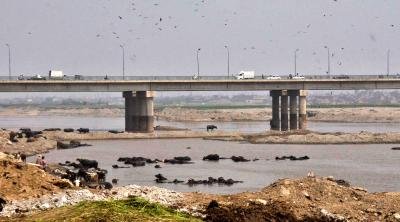
Islamabad, June 8 (IANS) The suspension of Indus Water Treaty (IWT) is not the original cause of Pakistan’s water crisis. In reality, rivers in Pakistan are running short due to Pakistani authorities’ failure to store the water it already controls, failure to modernise its irrigation system, protect the Indus delta and to distribute scarcity fairly among its provinces, a report has stated.
Following the heinous terror attack in Jammu and Kashmir’s Pahalgam in April 2025, India had exercised its rights as a sovereign nation under international law and placed Indus Water Treaty in abeyance until Pakistan stops its support for cross-border terrorism.
The Hague-based Clingendael Institute termed India’s decision a “pause of cooperation, not an end” and stated that the suspension came after Pahalgam attack and was framed by New Delhi in national-security terms, an opinion piece in Afghanistan’s Khaama Press highlighted. The move, analysts reckon, is more a strategic message than an instant cutoff.
Pakistan’s leadership has nevertheless blamed India for its water shortage problems. Pakistan’s narrative is politically useful as it helps to gain support of people and allows the authorities to avoid questions about mismanagement, weak storage, provincial mistrust, canal losses, groundwater depletion, floodplain neglect and poor crop planning.
“The suspension of the treaty may be a serious diplomatic escalation, but it is not the original cause of Pakistan’s water crisis. Pakistan’s rivers are not running short only because of an upstream neighbour. They are running short because the Pakistani state has spent decades failing to store the water it already controls, failing to modernise its irrigation system, failing to protect the Indus delta, and failing to distribute scarcity fairly among its own provinces. India’s move has given Islamabad a powerful external alibi. The deeper crisis, however, remains domestic,” Khaama Press opinion piece mentioned.
Despite receiving large seasonal river flows, Pakistan’s storage capacity remains low. Policy discussions in Pakistan have repeatedly stated that the country can store water for only about 30 days, far below the 120-day benchmark cited in national planning debates. For years, Pakistan has spoken about developing new dams, however, successive governments have not been able to build the provincial consensus needed to go ahead with the plan.
Apart from facing water shortage, Pakistan irrigation system remains inadequate, politically protected and slow to reform. Flood irrigation, leaky canals, weak pricing, poor crop choices and groundwater overuse have caused a permanent national condition in Pakistan.
“Per capita water availability tells the same story. According to water-sector estimates cited by Dawn and other Pakistani outlets, Pakistan’s annual per capita water availability has fallen from more than 5,000 cubic metres in the early years after independence to below 1,000 cubic metres today, a level widely associated with water scarcity. This collapse has been driven by population growth, inefficient use and poor governance. India did not create that long decline. Pakistani policymakers allowed it,” the Khaama Press article emphasised.
The distribution of water in Pakistan is also politically contested. Under the 1991 Water Apportionment Accord, the Indus River System Authority is supposed to regulate water distribution among provinces of Pakistan. However, in reality, the accord created a national framework. The lower riparian provinces, particularly Sindh, have said that shortages are not shared fairly and that Punjab, the upstream province, remains protected.
–IANS
akl/as