Chicago, Oct 3 (IANS) India offers low-cost clean energy, a nationwide power grid, inexpensive data, and a vast technology talent pool that make it an attractive destination for global data centres, Commerce and Industry Minister Piyush Goyal has told Indian-Americans in Chicago.
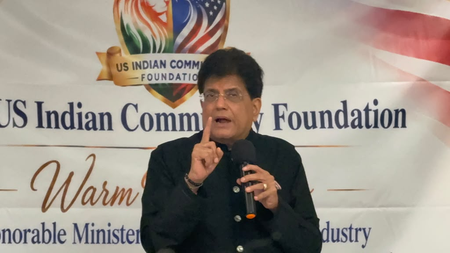
Addressing a community gathering organised by the US Indian Community Foundation, Goyal made a strong pitch for US companies and Indian-American entrepreneurs to invest in India, particularly in emerging technology and data infrastructure.
The event came after Goyal attended the G20 Trade Ministers’ Meeting in Milwaukee and held a series of engagements with American businesses and investors.
“Amongst the trusted world, countries where you feel safe with your data, where you feel safe to invest in the current geopolitical context, India is the world’s best location to house data centres,” Goyal said.
He said India’s power infrastructure had undergone a significant transformation since Prime Minister Narendra Modi took office in 2014.
India earlier had several regional grids, with different parts of the country facing varying levels of electricity shortages and surpluses, he said. The government connected the grids to strengthen reliability and support the expansion of renewable energy.
“So today, after China, we have the largest grid in the world,” Goyal said.
“India has a national grid. 520 gigawatts in one connected grid. And in another 6 or 7 years, this will become 1000 gigawatts,” he said.
Goyal said clean energy already accounts for 60 per cent of the installed capacity of the 520-gigawatt grid, including solar, wind, hydro and nuclear power.
“By 2033, when we are 1000 gigawatts, 70 per cent of this installed capacity will be clean energy,” he said.
The minister said the size and interconnected nature of the grid were particularly important for data centres because they require multiple levels of power redundancy.
“We can offer clean energy or renewable energy round the clock at the lowest price anywhere in the world,” Goyal said.
He said companies could currently secure 80 per cent guaranteed clean energy around the clock at seven to eight cents, while 100 per cent clean energy could cost about 11 or 12 cents.
“Nowhere in the world can you get this level of redundancy and clean energy together at these data points,” he said.
Goyal also pointed to India’s low data and infrastructure costs.
“The cost of data in India is amongst the lowest in the world, possibly the lowest in the world,” he said, adding that it could be around five to eight per cent of what users pay in the United States per gigabyte.
He told the gathering that creating data-centre infrastructure in India could cost between one-fourth and one-fifth of what it would cost in the United States or Europe.
Goyal also highlighted India’s pool of young technical talent, saying that about 1.4 million students graduate annually in science, technology, engineering and mathematics.
Earlier, the minister made a broader appeal to Indian-Americans to participate in India’s economic expansion through investment, technology, knowledge-sharing and entrepreneurship.
“The United States of America has capital strength, technology strength. India has ambition,” he said.
“The India-US partnership will continue to grow, will continue to prosper, will continue to provide opportunities to all of you,” Goyal said.
“You are all the ambassadors of India, you are the living bridge between India and the United States of America,” he added.
Goyal travelled to Chicago after participating in the G20 Trade Ministers’ Meeting in Milwaukee, where ministers discussed global trade challenges, the future of the World Trade Organisation and concerns over goods produced through forced labour and state-supported excess production capacity.
During his Chicago visit, Goyal also met US businesses and investors. He said he interacted with companies of different sizes through business groups and held several one-on-one meetings with large investors.
He also said India planned to bring a large, multi-sectoral business delegation to the region, possibly in the first quarter of next year.
–IANS
lkj/sd/