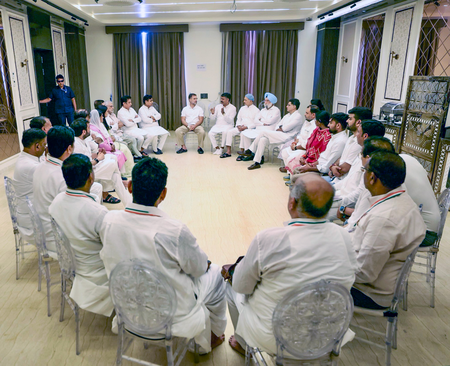
Jaipur, June 2 (IANS) Congress’ 10-day training camp in Pushkar has left Rajasthan abuzz over multiple issues, Leader of the Opposition (LoP) in Lok Sabha Rahul Gandhi’s dramatic ‘chair politics’ act, his public praise for LoP in the Assembly Tikaram Jully and Rajasthan Congress chief Govind Singh Dotasra, former Chief Minister Ashok Gehlot’s conspicuous absence, and Sachin Pilot’s energetic presence.
Altogether, these developments have triggered intense political discussion over the Congress party’s evolving strategy in Rajasthan. More than a routine brainstorming session, the Pushkar camp appears to signal a deliberate effort by the Congress high command to reshape Rajasthan politics and move beyond the faction-driven politics that have dominated the state unit for years.
The strongest political signal emerged from Rahul Gandhi’s unusual ‘chair politics’ demonstration. According to party sources, Rahul turned the dais into a symbolic political classroom. Some leaders were asked to enact the role of ticket aspirants circling around power centres, while others portrayed political sycophancy and the scramble for positions.
In a striking visual, Rahul reportedly asked PCC chief Govind Singh Dotasra to stand on a chair as if dispensing blessings, while other leaders stood before him in deferential postures. Former minister Ramlal Jat was then asked to pull the chair away. The symbolism was clear: politics should not become a blind pursuit of posts and power.
While Congress leaders hailed the exercise as innovative political communication, the Bharatiya Janata Party (BJP) attacked it as theatrics. Rajasthan minister Avinash Gehlot dismissed Rahul Gandhi’s Pushkar visit as “drama” and alleged that such acts would not help Congress regain power.
Congress leaders quickly countered. Dotasra argued that Rahul Gandhi’s message had been misunderstood. He said, “The message was simple: do not worship the chair. Work sincerely for people, and the people themselves will give you the chair.”
For nearly a decade, Rajasthan Congress politics revolved around two powerful personalities, Ashok Gehlot and Sachin Pilot. Their rivalry shaped government formation in 2018 and later erupted into a full-scale political crisis during the Manesar rebellion. But in Pushkar, Rahul Gandhi appeared keen to draw a line under that era.
During extensive interactions with district presidents, senior leaders, and party office-bearers, Rahul delivered a clear message: Congress can return to power only if leaders and workers function as one team.
The era of winning elections solely on the shoulders of one or two charismatic leaders, he indicated, is over. Instead, Rahul stressed booth-level strengthening, accountability, and rebuilding the organisation from the grassroots.
Separate meetings with district presidents focused on ground realities, organisational weaknesses, and strategies to revive the Congress machinery at the local level.
Rahul Gandhi’s repeated praise for Dotasra and Jully added another layer to the political messaging. Observers view this as more than routine appreciation and as a signal from the high command in favour of organisational leadership over factional alignments.
The timing is significant, especially amid speculation over possible changes in the state leadership. Rahul’s endorsement appears to have strengthened Dotasra’s hold over the organisation, while Jully emerged politically stronger through praise for his aggressive role against the BJP government in the Assembly.
At the same time, Ashok Gehlot’s absence generated its own political chatter. Though health concerns were cited after he returned to Jaipur from Kishangarh Airport, speculation persisted.
In contrast, Sachin Pilot remained highly active throughout the camp, strongly advocating issues concerning youth, farmers, women, and unemployment, subjects closely aligned with Rahul Gandhi’s national political narrative.
The Pushkar Chintan Shivir thus appeared to be more than an organisational exercise. It increasingly looked like an attempt by the Congress leadership to bury old factional battles and prepare the Rajasthan Congress for a new political model, one driven less by individual power centres and more by collective leadership and organisational discipline.
–IANS
arc/dan