
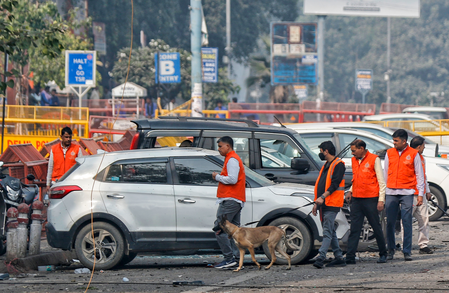
New Delhi, Nov 11 (IANS) The investigation into last year’s Red Fort car blast in Delhi unearthed several crucial details about the attack and the manner in which the Faridabad module had been established.
Investigators were particularly struck by the meticulous planning behind the attack and the precision with which members of the Faridabad module had carried out their assigned tasks.
The members of the module not only managed to stay under the radar of security agencies but also procured thousands of kg of ammonium nitrate without attracting suspicion.
Despite the elaborate planning, however, the Red Fort blast was triggered prematurely, and the execution of the attack ultimately fell short of what the perpetrators had intended.
An official said that the bigger picture that one needs to look into is the radicalisation aspect.
“The module was not merely planning a major attack aimed at causing mass casualties. It had a much larger agenda, which was to overthrow the government in New Delhi,” the official added.
The literature recovered from the Faridabad module, also known as the ‘Doctor’s module’, along with its plans, points to an agenda that went far beyond carrying out terror attacks.
According to the official, the module also intended to impose Sharia law in India. To achieve this objective, its members had allegedly planned to overthrow the Union government, the official said.
Another official said that the mindset of these doctors part of the Faridabad module was dangerous.
“However, the bigger danger is that many more within the country may try and replicate what this module did or may be in the process of doing so,” the official said.
Such radicalisation modules tend to create a chain effect.
Outfits such as the Islamic State and Al-Qaeda inspire such modules to come up in large numbers across the country.
These terror groups are aware that to throw out a government and implement the Sharia law cannot be undertaken by one single module. The idea is to have scores of such modules across the country.
Although these modules would not be interconnected their goals would remain the same, the official said.
An Intelligence Bureau official said that one must also take into account the modus operandi of the Faridabad module.
“They were not just planning on creating an uprising by relying heavily on propaganda material. This group operated in seclusion and planned on a series of deadly attacks across North India. The idea was to inflict maximum damage and then pressurise the government to step down,” the official added.
Post the multiple blasts, such modules usually tend to focus on messaging.
The attack coupled with propaganda makes a module extremely dangerous. Such a modus-operandi also tends to stress out the security mechanism in the country.
Now imagine if multiple such modules are in operation and carry out similar activities simultaneously.
They manage to cover the length and breath of the country, while also posing an immense challenge to the security agencies, the official said.
With their ground operations severely curtailed, the Islamic State and Al-Qaeda have increasingly focused on region-specific radicalisation efforts, aiming to establish Faridabad-style modules in different pockets across states.
These modules are designed to function independently, without any operational links with one another. This makes it difficult for investigators to establish connections between them and trace the wider network behind their activities.
In many ways, such modules resemble lone actors. Their members operate without direct contact with other groups, acquire the skills required to manufacture explosives on their own and independently arrange the materials needed for their activities.
They are also largely self-funded, leaving investigators with little or no financial trail to follow. Modules inspired by the Islamic State and Al-Qaeda have been structured to function much like lone actors, thereby making detection and investigation more challenging, an official said.
–IANS
vn/snj/khz


