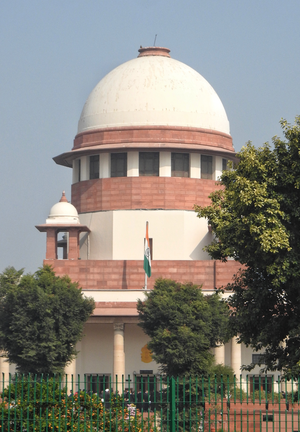
New Delhi, Oct 29 (IANS) The Supreme Court on Thursday disposed of pleas filed by the Chhattisgarh government challenging the grant of bail to retired IAS officer Anil Tuteja in connection with the alleged liquor scam and custom rice milling scam cases, while clarifying that the state government can approach the High Court for cancellation of bail if he is found to have misused his liberty.
A Bench of Chief Justice of India (CJI) Surya Kant and Justices Joymalya Bagchi and V. Mohana said that any alleged misuse of the concession of bail could be brought to the notice of the Chhattisgarh High Court for appropriate action.
“If there is any misuse of the concession of bail, you can approach the High Court for immediate cancellation of bail,” the CJI Kant-led Bench observed during the proceedings.
The apex court also clarified that the observations made by the Chhattisgarh High Court while granting bail to Tuteja were confined to the consideration of his bail applications and would not influence the trial court while deciding the cases on merits.
“The findings made by the High Court are for the limited purpose of granting bail. The trial court shall not be influenced by those observations,” the Supreme Court said.
It further observed that if any instance of misuse of bail came to light, the state government would be at liberty to seek cancellation of the relief before the High Court in accordance with law.
The Chhattisgarh government had challenged the High Court’s orders granting regular bail to Tuteja in the two cases. The special leave petitions (SLPs) were dismissed, with the Supreme Court preserving the state government’s right to seek cancellation of bail in the event of any violation or misuse of the concession.
In the alleged custom rice milling scam case, the Chhattisgarh High Court granted regular bail to Tuteja on January 13, 2026, in a case registered by the Economic Offences Wing (EOW)/Anti-Corruption Bureau (ACB) under provisions of the Indian Penal Code (IPC) and the Prevention of Corruption Act.
The case relates to allegations of illegal collections from rice millers in Chhattisgarh under the guise of incentives for custom milling. The prosecution had claimed that the collections formed part of a wider conspiracy involving public servants and private individuals, while Tuteja denied the allegations.
Granting bail, a single-judge Bench of Justice Arvind Kumar Verma had taken into account the period of custody undergone by Tuteja, the stage of investigation, the nature of the evidence and the likelihood of a prolonged trial.
In its order, the High Court had also recorded that the prosecution had not obtained the requisite sanction to prosecute Tuteja, thereby preventing the trial court from taking cognisance of the charges against him. It observed that the seriousness of the allegations alone could not justify continued incarceration, particularly when the trial was unlikely to conclude within a reasonable period.
The High Court had made it clear that its observations were limited to the adjudication of the bail application and would not be treated as an opinion on the merits of the case. Subsequently, on March 3, 2026, the High Court granted Tuteja regular bail in the alleged liquor scam case, registered by the EOW/ACB in Raipur under provisions of the IPC and the Prevention of Corruption Act.
In that case, the High Court observed that Tuteja had remained in custody for more than 18 months and that the prosecution involved a large number of accused, witnesses and documents, making an early conclusion of the trial unlikely.
The High Court said that the relief was being granted on the ground of prolonged incarceration and the likelihood of delay in the investigation and trial, without expressing any opinion on the merits of the allegations.
It also specifically preserved the prosecution’s liberty to seek cancellation of bail in the event of a breach of the conditions imposed on Tuteja.
–IANS
pds/dan