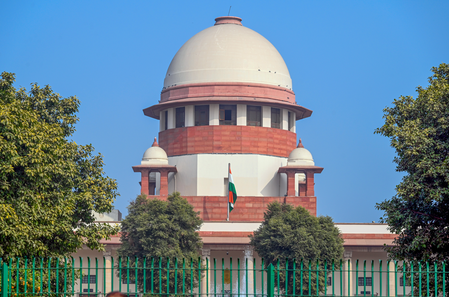
New Delhi, Sep 29 (IANS) The Supreme Court has quashed the preventive detention of UP cleric Mulla Afroz under the National Security Act (NSA) in connection with the 2024 Sambhal violence case, holding that a confessional statement made before a police officer cannot, by itself and without independent supporting material, form the basis for preventive detention.
A Bench of Justices Dipankar Datta and Sheel Nagu set aside the Allahabad High Court judgment upholding Afroz’s detention order, as well as the detention and confirmation orders, and directed that he be released forthwith unless his custody was required in any other case.
The apex court also imposed costs of Rs 10 lakh on the Uttar Pradesh government, directing that the amount be paid to Afroz within one month from the date of the judgment.
The case arose from violence during a survey of a mosque in Sambhal on November 24, 2024, in which four persons died.
Although Afroz was not named in the FIR registered on the day of the incident, he was arrested around 54 days later, on January 17, 2025, in connection with other FIRs.
During his custody, an extra-judicial confessional statement was recorded, and a .32 bore pistol was stated to have been recovered.
Afroz was granted bail in one of the cases in September 2025, following which the Sambhal District Magistrate passed an NSA detention order on October 13, 2025.
The state government subsequently confirmed the detention for a further period of 12 months.
By June 2026, Afroz had secured bail in all the criminal cases arising from the incident.
The Supreme Court identified two broad issues for consideration — whether an order of preventive detention could be based on an extra-judicial confession and whether the procedural safeguards under the Constitution and the NSA had been complied with.
It held that such a statement, particularly when the appellant had consistently alleged that it was obtained through threats and torture, could not constitute the basis for subjective satisfaction in the absence of independent supporting material.
“Therefore, we are of the considered opinion that a confessional statement made before a police officer cannot, by itself, and in the absence of any independent material lending support thereto, constitute a basis for forming the subjective satisfaction necessary to sustain an order of preventive detention,” the Justice Datta-led Bench said.
The apex court said a police confession is treated with suspicion under Section 23 of the Bharatiya Sakshya Adhiniyam and has to be tested against the constitutional protection against self-incrimination under Article 20(3).
It observed that if a confession was considered too tainted to be received in evidence for proving guilt, its use as a substantive basis for preventive detention would require “a deeper scrutiny”.
At the same time, the Supreme Court clarified that where a detention authority relies upon other material apart from a confessional statement, the validity of the detention has to be examined on the basis of such independent material.
The bench further held that the existence of multiple criminal cases, by itself, could not justify preventive detention unless supported by “cogent and reliable material”.
It observed that preventive detention involves curtailment of personal liberty not for what a person has already done, but for what is apprehended that the person may do in future.
“Preventive detention has always been regarded as an exceptional measure,” the Supreme Court said, adding that it must be invoked “with the utmost circumspection”.
The bench further held that material relied upon to justify preventive detention must establish the necessity of preventing future prejudicial conduct and should not merely reinforce allegations already forming the subject matter of an ongoing criminal prosecution.
However, the apex court made it clear that it was expressing no opinion on the merits of the criminal cases against Afroz, which would proceed in accordance with law.
The Supreme Court ultimately held that the Allahabad High Court judgment and the detention and confirmation orders could not be sustained in law and set them aside.
Recording that the detention order was passed on October 13, 2025 and confirmed on November 28, 2025, for one year, it observed that Afroz had already suffered considerable loss of liberty despite securing bail in all the cases relating to the incident.
“In such circumstances, the process was made the punishment,” it said, allowing the appeal and directing Afroz’s release and payment of Rs 10 lakh in costs by the state government.
–IANS
pds/vd